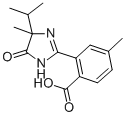
Imazamethabenz is registered in North America and
Europe for use as a post-emergent herbicide on most
major varieties of wheat (spring andwinter), barley (spring
and winter), and rye as well as some varieties of winter
triticale and sunflower and safflower (1). It is applied at
0.35–0.53 kg ai/ha in wheat and barley and 0.2–0.43 kg
ai/ha in sunflowers. A nonionic surfactant or oil adjuvant
is required for maximum activity.
Imazamethabenz is synthesised through a multi-step process that builds its imidazolinone core and attaches functional groups for herbicidal activity. The synthesis typically begins with the formation of a substituted imidazolinone ring, often derived from the condensation of methyl isobutyraldehyde with cyanamide and acetic acid derivatives under controlled conditions. This intermediate is then coupled with a benzoic acid derivative, such as 2-methylbenzoic acid, through an acylation or esterification reaction to form the final active compound. The product is usually formulated as a toluate ester, which enhances its solubility and uptake in plants.
Selective, systemic absorbed through roots and leaves. Inhibits plant amino acid synthesis - acetohydroxyacid synthase AHAS.