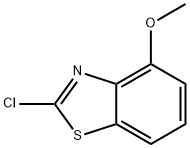
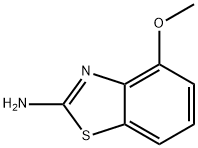
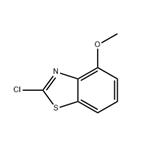
The general procedure for the synthesis of 2-chloro-4-methoxybenzo[d]thiazole using 2-amino-4-methoxybenzothiazole as starting material was as follows: copper(II) chloride (3.36 g, 25.0 mmol), acetonitrile (71 mL), and isoamyl nitrite (2.2 mL, 16.6 mmol) were added to a 500 mL three-neck flask equipped with a condenser under nitrogen protection. The suspension was placed in a 65 °C oil bath and stirred for 10 min, followed by the slow addition of a solution of 2-amino-4-methoxybenzothiazole (2.00 g, 11.1 mmol) in acetonitrile (42 mL). The reaction mixture was stirred continuously in an oil bath at 65 °C for 2 h and subsequently cooled to 20 °C. Water (150 mL) and 1N hydrochloric acid (100 mL) were added to the reaction mixture, followed by extraction with ethyl acetate (3 x 100 mL). The organic layers were combined, washed with saturated brine, dried over anhydrous sodium sulfate, filtered and concentrated. The resulting residue was purified by silica gel column chromatography (5% to 15% gradient with ethyl acetate in hexane as eluent) to afford 2-chloro-4-methoxybenzo[d]thiazole (1.52 g, 69% yield) as a white solid.