
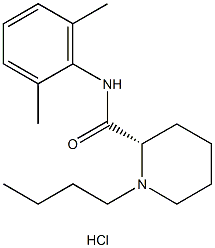
Levobupivacaine was first launched in the US for the production of
local anesthesia for surgery and obstetrics and for post-operative pain management. It is
the (S)-enantiomer of the long acting, highly potent local anesthetic bupivacaine
(Marcaine) that can be prepared by a three step sequence from (S)-pipecolic acid or from
(S)-lysine by oxidative deamination and stereospecific ring closure to (S)-pipecolamide
core structure. Levobupivacaine exhibits its long-acting local anesthetic effect by blocking
neuronal sodium channel ion flow in nerve axons. Clinical studies demonstrated an
efficacy and a general profile closely resembling those of the racemic bupivacaine
currently in use; however, it produced an enhanced safety profile, in particular
substantially reduced (about one-third) cardiotoxicity (less effect on myocardial contractility
and QT, prolongation) and CNS depressive side effects. Onset and duration of blockade
were also equivalent or even better.