
ChemicalBook
製品カタログ
味と香り
合成香料
カルボン酸エステルとスパイス
芳香族カルボン酸エステル
rel-(1S*,4β*)-1α*,7,7-トリメチルビシクロ[2.2.1]ヘプタン-2α*-オールアセタート
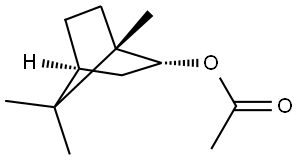
rel-(1S*,4β*)-1α*,7,7-トリメチルビシクロ[2.2.1]ヘプタン-2α*-オールアセタート
化学名:rel-(1S*,4β*)-1α*,7,7-トリメチルビシクロ[2.2.1]ヘプタン-2α*-オールアセタート
CAS番号.76-49-3
英語名:Bornyl acetate
CBNumberCB1352245
MFC12H20O2
MW196.29
MOL File76-49-3.mol
别名
ボルニルアセタート
1,7,7-トリメチルビシクロ[2.2.1]ヘプタン-2-オールアセタート
酢酸イソボルニル
more
rel-(1S*,4β*)-1α*,7,7-トリメチルビシクロ[2.2.1]ヘプタン-2α*-オールアセタート物理性質
| 融点 | 27–29 °C |
| 沸点 | 223–224 °C |
| 比旋光度 | -41 º (neat) |
| 比重(密度) | 0.985 g/mL at 25 °C(lit.) |
| 屈折率 | n |
| FEMA | 2159 | BORNYL ACETATE |
| 闪点 | 192 °F |
| 貯蔵温度 | Store at -20°C |
| 溶解性 | DMF: 25mg/mL; DMF:PBS (pH 7.2) (1:3): 0.25mg/mL; DMSO: 2mg/mL; Ethanol: 15mg/mL |
| 外見 | An oil |
| 色 | Colorless to light yellow |
| 臭い (Odor) | 100.00%で。ウッディーパイン ハーブ シダー スパイス |
| においのタイプ | バルサミコ |
| Merck | 13,1329 |
| JECFA Number | 1387 |
| Dielectric constant | 4.6(21℃) |
| 化粧品成分の機能 | 香料 |
| LogP | 3.86 |
show more
rel-(1S*,4β*)-1α*,7,7-トリメチルビシクロ[2.2.1]ヘプタン-2α*-オールアセタート 化学特性,用途語,生産方法
このような結果となっており、現時点で化粧品における使用実績がほとんどないものの、一般に安全性に問題のない成分であると考えられます。
展望
ボルニル酢酸エステルの応用は現在も進化しており科学者たちはこの物質の新たな用途と機能を探求し続けていますナノテクノロジーやバイオテクノロジーの分野ではこの種の化合物が持つ独特な性質を利用して新しいタイプの材料や治療法の開発につながる可能性が探られていますまた持続可能な資源としての価値も再認識されており環境に優しい製品の開発において重要な役割を果たしています化学的特性
ボルニル酢酸エステルは独特な香りを持つ化学物質であり特に香水や芳香剤などの香料として広く利用されています化学式はC12H20O2で表されこの化合物はモノテルペン類に分類されるテルペノイドの一種です天然には特定の植物から抽出することで得られることが多くボルネオールと酢酸とのエステル化反応によって合成されます化学的特性
Bornyl acetate occurs in its optically active forms and as a racemate in many essential oils.(1S,2R,4S)-()-Bornyl acetate is a characteristic component of most conifer oils. It has a camphoraceous, pine-needle-like odor. Both (1R,2S,4R)- (+)-bornyl acetate and ()-bornyl acetate form colorless crystals; the racemate is a colorless liquid. Bornyl acetate is prepared by esterification of borneol with acetic anhydride or via the process described under borneol.
Due to its characteristic pine-needle odor, bornyl acetate is frequently used in conifer needle compositions, soaps, bath products, room sprays, and pharmaceutical products.
天然物の起源
Reported found in the oils of Abies canadensis, A. concolor, Picea canadensis, P. rubens, P. orientalis, Pinus densiflora, Larix americana, Callitris drum-mondi, Abies alba, Pinus punulio, Abies sibirica L., and in coriander, thyme and valerian oil; it has been identified in the essence from flowers of Chrysanthemum sincuse Sabin, in the distillate of Teucrium chamaedris L., and in the fresh rhizomes of Valeriana officinalis L.; d-bornyl acetate is found in the essential oils of Callitris glauca, C. robusta, C. gracilis, C. verrucosa and C. calcarata; the presence of acetate has been excluded from the essence of lavender and lavandin.使用
Antineoplastic; radioactive agent.安全性
ボルニル酢酸エステルは一般的には安全とされる化合物ですが過剰な使用や不適切な取り扱いは皮膚刺激やアレルギー反応を引き起こす可能性があります製品に使用される際には適切な濃度と純度が保たれるように管理されていますまた環境への影響については生分解性が高いため適切に処理されれば環境汚染のリスクは低いと考えられますしかし全ての化学物質と同様に生態系への潜在的な影響については引き続き研究と監視が必要です参考文献
- 有限会社久光工房(-)「酢酸ボルニル」Cosmetic-Info.jp, 2025年11月2日アクセス.
- ⌃有機合成化学協会編(1985)「ボルニルアセタート」有機化合物辞典,974.
- 特許庁(2001)「官能基別合成香料の例 エステル 1.脂肪族酸のエステル」特許庁広報 周知・慣用技術集(香料)第Ⅲ部 香粧品用香料,87-96.
- 堀内 哲嗣郎(2010)「香料業界で用いる専門用語」香り創りをデザインする -調香の基礎からフレグランスの応用まで-,32-38.
- 奥田 治, 他(2000)「香調の表現および分類」香料と化粧品の科学,51-53.
- ⌃兼井 典子(2003)「香りの化学」化学と教育(51)(2),86-88. DOI:10.20665/kakyoshi.51.2_86.