
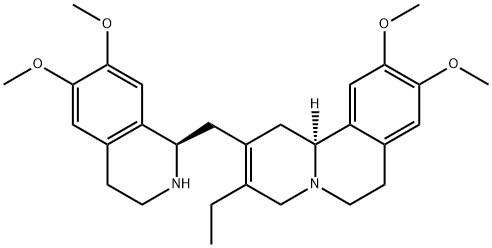
dehydroemetine
- Product Namedehydroemetine
- CAS4914-30-1
- CBNumberCB9942510
- MFC29H38N2O4
- MW478.62
- EINECS225-542-7
- MDL NumberMFCD01729551
- MOL File4914-30-1.mol
Chemical Properties
| Melting point: | 94-96° |
| alpha | D -183° |
| Boiling point: | 604.7±55.0 °C(Predicted) |
| Density | 1.19±0.1 g/cm3(Predicted) |
| storage temp. | Store at -20°C |
| pka | 8.86±0.40(Predicted) |
| form | Solid |
| color | Off-white to light yellow |
dehydroemetine Chemical Properties,Usage,Production
Pharmacology and mechanism of action
Dehydroemetine, is a derivative of emetine and has similar pharmacological properties, but it is considered to be less toxic. Dehydroemetine acts against Entamoeba histolytica in tissue and has little effect on amoeba confined to the lumen of the bowel. It has a direct amoebicidal effect in vitro by interfering with the mRNA translocation along the ribosome, which causes inhibition of protein synthesis [1].Indications
Serious intestinal amoebiasis and amoebic hepatitis with liver abscess. Dehydroemetine is usually given with chloroquine. It is only indicated when other safer drugs are not available or contraindicated.Side effects
Side effects are similar to those caused by emetine, but they are milder and less frequent. They are largely gastrointestinal, cardiac and neuromuscular reactions. Gastrointestinal reactions include nausea, vomiting, and abdominal pain. Neuromuscular effects are generalized muscle weakness, muscle pain and stiffness of the limbs and neck. Cardiac effects include fall in blood pressure, tachycardia and ECG changes of T-wave flattening or inversion [2,3]. The injection of dehydroemetine is painful and the formation of an abscess is common [2].Contraindications and precautions
Patients with heart, muscle, or neurological diseases or in poor general condition should be treated with great caution. Dehydroemetine should always be given under medical supervision. Strenuous exercise should be forbidden until 4–5 weeks after completion of therapy[4]. Dehydroemetine should not be given earlier than 1.5–2 months after emetine treatment because of cardiotoxicity.Previous recommendations to use a contact amoebicide (e.g. di-iodohydroxyquinoline) together with an oral drug preparation can no longer be supported. The hydroxyquinolines have been withdrawn from most markets because of their potential risk of inducing subacute myelo-optic neuropathy (SMON).
Interactions
There have been no reports.Preparations
Available as dehydroemetine hydrochloride: 100 mg salt equals 87 mg base.• Dehydroemetine® (Roche) Ampoules 30 mg/ml, ampoules 60 mg/2 ml.
References
1. Westwood JT, Wagenaar EB (1983). Chinese hamster cells can be reversibly blocked before mitosis with the protein synthesis inhibitor Emetine. J Cell Sci, 59, 257–268.2. Salem HH, Abd-Rabbo H (1964). Clinical trials with dehydroemetine dihydrochloride in the treatment of acute amoebiasis. J Trop Med Hyg, 67, 137–141.
3. Powell SW, Wilmot AJ, McLeod IN et al. (1965). Dehydroemetine in the treatment of amoebic liver abcess. Ann Trop Med Parasitol, 59, 208–209.
4. Wilmot AJ (1962). Clinical Amoebiasis (Oxford: Blackwell Scientific Publications).
Uses
Dehydroemetine is an orally active antiparasitic agent. Dehydroemetine can inhibit parasites such as Entamoeba histolytica, and it can also be used in the research of parasitic diseases like visceral leishmaniasis[1][2][3].Definition
ChEBI: Dehydroemetine is a pyridoisoquinoline which was developed in response to the cardiovascular toxicity associated with emetine and results from the dehydrogenation of the heterotricylic ring of emetine. It is an antiprotozoal agent and displays antimalarial, antiamoebic, and antileishmanial properties. It has a role as an antiprotozoal drug, an antimalarial and an antileishmanial agent. It is a member of isoquinolines, an aromatic ether and a pyridoisoquinoline. It derives from a hydride of an emetan.Pharmaceutical Applications
The synthetic racemic derivative of the plant alkaloid emetine. Formulated as the hydrochloride for intramuscular administration. Like the parent compound, emetine, it inhibits E. histolytica at concentrations of 1–10 mg/L in vitro, but it is more active than the parent in animal models. Drugresistance in E. histolytica is rare.No human pharmacokinetic data are available. A halflife of 2 days, compared with 5 days for emetine, has been reported. There is selective tissue binding and accumulation in the liver, lung, spleen and kidney.
It is considerably less toxic than emetine, possibly because it is more rapidly eliminated. Nevertheless, nausea, vomiting, diarrhea and abdominal cramps frequently occur. Neuromuscular effects have also been reported. More serious cardiotoxic effects can lead to electrocardiogram (EGG) changes, tachycardia and a drop in blood pressure.
It was formerly used as a second-line treatment in severe intestinal or hepatic amebiasis, but is no longer recommended for use.
in vivo
Dehydroemetine (10 mg/kg; intravenous injection; single dose) is mainly distributed in the liver and spleen in mice, with a relatively low concentration in the heart[3].
IC 50
LeishmaniaReferences
[1] SALEM HH, et al. DEHYDROEMETINE IN ACUTE AMOEBIASIS. Trans R Soc Trop Med Hyg. 1964 Nov;58:539-44. DOI:10.1016/0035-9203(64)90110-5[2] Salako LA. Pharmacodynamic effects of dehydroemetine. J Pharm Pharmacol. 1972 Jan;24(1):32-9. DOI:10.1111/j.2042-7158.1972.tb08861.x
[3] Fouarge M, et al.Development of dehydroemetine nanoparticles for the treatment of visceral leishmaniasis.J Microencapsul. 1989 Jan-Mar;6(1):29-34. DOI:10.3109/02652048909019899
dehydroemetine Supplier
Global(20)Suppliers
| Supplier | Tel | Country | ProdList | Advantage | |
|---|---|---|---|---|---|
| +86-0371-55170693 +86-19937530512 | info@tianfuchem.com | 21533 | 55 | ||
| +1-631-485-4226 | inquiry@bocsci.com | 19935 | 58 | ||
| +1-781-999-5354; +1-00000000000 | marketing@targetmol.com | 32431 | 58 | ||
| +86-29-81148696 +86-15129568250 | 1022@dideu.com | 29086 | 58 | ||
| +86-18621343501 | product@acmec-e.com | 33301 | 58 | ||
| tp@aladdinsci.com | 50068 | 58 | |||
| +8613817748580 | cooperation@kean-chem.com | 40048 | 58 | ||
| +86-88938639 +86-17705817739 | info@dycnchem.com | 53586 | 58 | ||
| 13370042665 18916960931 | 2596183085@qq.com | 17234 | 58 | ||
| 18916372613 | yanzihan@shyuanye.com | 87240 | 60 |