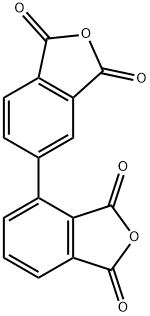
Description
2,3,3,4-biphenyl tetracarboxylic dianhydride, also known as a-BPDA, is a high-performance polymer with excellent heat resistance, solvent resistance, radiation resistance, and impressive mechanical and dielectric properties. It holds great potential for applications across numerous industries and material fields.
Chemical Properties
White to Almost white powder to crystal.
Uses
2,3,3',4'-Biphenyltetracarboxylic dianhydride be used for the preparation of a polyimide material.
Preparation
The preparation of 2,3,3',4'-biphenyl tetracarboxylic dianhydride is as follows:In a 1000 ml three-necked flask, 18.3 g (0.1 mol) of 4-chlorophthalic anhydride and 18.3 g (0.1 mol) were added 3-chlorophthalic anhydride, 300 g of anisole as solvent, 0.13 g (0.001 mol) of nickel chloride as a catalyst, 0.198 g (0.001 mol) of C-1 as a catalyst ligand, and 0.03 g (0.0003 mol) of sodium bromide as a catalyst Auxiliary, 13 g (0.2 mol) of zinc powder was used as a reducing agent, and the reaction was stirred at 30 ° C for 8 hours under a nitrogen atmosphere. The reaction solution was filtered to remove insoluble solids in the reaction liquid. 300 g of methanol was added to the filtration mother liquor, and the product was precipitated, filtered, and dried to obtain 25.8 g of the product 2,3,3',4'-biphenyltetracarboxylic dianhydride, yield 87.7%.

Application
2,3,3,4-biphenyl tetracarboxylic dianhydride (a-BPDA) and polyamides (PAA) derived from p-phenylenediamine (PDA) or 4,4'-oxydiphenylamine (ODA) undergo thermal imidisation and can be used for the preparation of asymmetric biphenyl-type polyimides (PI). Compared to the semi-rigid s-BPDA/PDA, the a-BPDA/PDA polyimides have a significantly bent chain structure. However, a-BPDA/PDA films annealed at 350 °C show higher Tg than s-BPDA/PDA films prepared under the same conditions. a-BPDA-based PIs have unexpectedly high Tg values, which may be attributed to the cranked axial motion limiting conformational changes. The diimide synthesised from a-BPDA and cyclohexylamine displays long-lived luminescence of up to 1.3 s after UV irradiation.
Synthesis
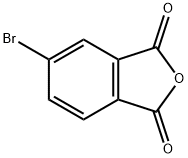
In a 1000 mL three-neck flask, 18.3 g (0.1 mol) of 5-bromoisobenzofuran-1,3-dione and 18.3 g (0.1 mol) of 3-bromophthalic anhydride were added, 300 g of anisole was used as a solvent, 0.13 g (0.001 mol) of nickel chloride was used as a catalyst, 0.198 g (0.001 mol) of C-1 was used as a ligand for the catalyst, 0.03 g (0.0003 mol) sodium bromide as catalyst cofactor and 13 g (0.2 mol) zinc powder as reducing agent. The reaction mixture was stirred at 30 °C for 8 h under nitrogen protection. Upon completion of the reaction, the reaction solution was filtered to remove insoluble solids. To the filtrate was added 300 g of methanol and the product was precipitated, filtered and dried to give 25.8 g of [4,5'-diisobenzofuran]-1,1',3,3'-tetrone in 87.7% yield. The synthesis method is similar to Example 1, with the main difference being that differently substituted phthalic anhydrides were used as raw materials.
References
[1] Patent: CN108250169, 2018, A. Location in patent: Paragraph 0010; 0055; 0065-0067