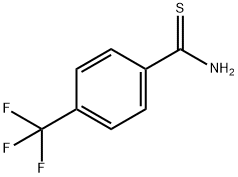
Uses
As an electrolyte additive, 4-(Trifluoromethyl)thiobenzamide (TFSBN) enhances cycling stability and overall performance by forming an inorganic-rich cathode electrolyte interphase (CEI) through reactions at its sulfur and nitrogen sites[6].
Synthesis
The general procedure for the synthesis of 4-(trifluoromethyl)thiobenzamide from 4-trifluoromethylbenzonitrile was as follows: 500 mg (2.92 mmol) of 4-trifluoromethylbenzonitrile was reacted with 702 mg (8.7 mmol) of sodium thiohydride for 3 hr at 60 °C. Ethanol was used as a solvent during the reaction, and the ethanol was removed by distillation after the reaction was completed. Subsequently, ethyl acetate was added to the reaction mixture and the resulting solution was washed with water. The organic layer was dried with anhydrous magnesium sulfate and then the solvent was removed by distillation. The residue was purified by column chromatography to give 517 mg (95% yield) of 4-(trifluoromethyl)thiobenzamide. The product could be used in the next step of the reaction without further purification. Mass spectrometry (EI) showed a molecular ion peak of 152 (M++1).
References
[1] Journal of Medicinal Chemistry, 2014, vol. 57, # 8, p. 3213 - 3222
[2] Patent: WO2005/40127, 2005, A1. Location in patent: Page/Page column 100-101
[3] Journal of Fluorine Chemistry, 2006, vol. 127, # 1, p. 63 - 67
[4] Patent: WO2004/6922, 2004, A1. Location in patent: Page/Page column 27; 28
[5] RSC Advances, 2018, vol. 8, # 1, p. 170 - 175
[6] Kang, G., Cao, Y., Liu, Q., Duan, J., Zhang, Y., Kang, F., & Cao, Y. (2025). Efficient Screening of Electrolyte Additives for High-Temperature, High-Voltage Lithium Batteries via Fukui Functions. Advanced Functional Materials, 36(18).
https://doi.org/10.1002/adfm.202522713