Chemical Properties
White powder;Light yellow powder
Uses
A matabolite of tryptophan and a putative NMDA receptor agonist.
Uses
An inhibitor of glucose synthesis.
Uses
Inhibits glucose synthesis
Uses
Quinolinic acid is an endogenous NMDA agonist. Quinolinic acid is a metabolite of tryptophan that acts as a putative NMDA receptor agonist. Quinolinic acid is an excitotoxic metabolite and an agonist of N-methyl-D-aspartate receptors. properties of KYNA raise the possibility of a functional link between KYNA and QUIN in the brain which may be of relevance for an understanding of human neurodegenerative disorders. Quinolinic acid is a potent endogenous excitant at amino acid receptors in CNS.
Definition
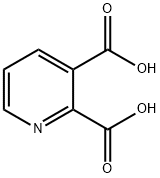
ChEBI: Quinolinic acid is a pyridinedicarboxylic acid that is pyridine substituted by carboxy groups at positions 2 and 3. It is a metabolite of tryptophan. It has a role as a NMDA receptor agonist, a human metabolite, a mouse metabolite and an Escherichia coli metabolite. It is a conjugate acid of a quinolinate(1-) and a quinolinate.
Biosynthesis
The 3-hydroxyanthranilic acid oxygenase (3-HAO) catalyzes the conversion of 3-hydroxyanthranilic acid (3-HA) acid to an unstable intermediate, aminocarboxymuconic semialdehyde, which then preferentially converts to QUIN by a nonenzymatic cyclisation. This intermediate compound can also produce picolinic acid instead of QUIN. Finally, QUIN is catabolized to NAD+ and carbon dioxide by the action of quinolinate phosphoribosyl transferase (QPRT). This enzyme has been identified in rat and human CNS tissue[1].
Synthesis Reference(s)
Journal of the American Chemical Society, 71, p. 3020, 1949
DOI: 10.1021/ja01177a021
Hazard
A poison by skin contact. Moderately toxic
by ingestion. A mild skin irritant.
Industrial uses
The use of quinolinic acid during flotation of hematite results in the adsorption of quinoline on hematite, allowing amine to selectively adsorb onto the hematite surface.
Biological Activity
Endogenous NMDA agonist and transmitter candidate. May distinguish between NMDA receptor subtypes.
Biological Activity
Quinolinic acid (QA) is a 2,3-pyridine dicarboxylic acid (C7H5NO4). QA is produced following the metabolic breakdown of the amino acid tryptophan, via the kynurenine pathway. Tryptophan is able to cross the blood–brain barrier (BBB), and upon entering the brain, is taken up by astrocytes, macrophages, microglia, and dendtritic cells and converted into kynurenine. In the presence of the enzyme 3-hydroxyanthranilic acid, kynurenine is converted into QA through a series of enzymatic reactions. QA is normally present in extremely low, nanomolar concentrations in the brain and in cerebrospinal fluid and does not cause damage to the surrounding cells. Accumulation of endogenous QA has recently been implicated in the etiology of certain neurodegenerative diseases, especially those with a strong inflammatory component, such as Parkinson’s disease (PD), amyotrophic lateral sclerosis (ALS), Huntington’s disease (HD), Alzheimer’s disease (AD), stroke, multiple sclerosis (MS), and epilepsy[1].
Safety Profile
A poison by skin contact. Moderately toxic by ingestion. Experimental reproductive effects. A mdd skinn irritant. When heated to decomposition it emits toxic vapors of NOx.
References
[1] Rafael Lugo-Huitrón. “Quinolinic acid: an endogenous neurotoxin with multiple targets.” Oxidative Medicine and Cellular Longevity (2013): 104024.