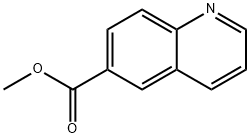
Uses
Methyl quinoline-6-carboxylate serves as a precursor for quinoline-based Schiff base derivatives: refluxing it with hydrazine hydrate in methanol gives quinoline-6-carbohydrazide, which is then refluxed with aromatic aldehydes in the presence of glacial acetic acid to form the hydrazide derivatives[6].
Synthesis
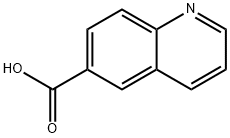
At 0 °C, 6.0 mmol of thionyl chloride was slowly added dropwise to a 5 mL methanol solution containing 2.0 mmol of 6-quinoline carboxylic acid. Subsequently, the reaction mixture was warmed up to 50 °C with continuous stirring for 12 hours. Upon completion of the reaction, 30 mL of saturated aqueous NaHCO3 solution was added to the mixture to neutralize the reaction. The reaction mixture was extracted three times using 30 mL of dichloromethane and the organic phases were combined. The organic phase was dried over anhydrous MgSO4 and filtered to remove the desiccant. The organic solvent was removed by concentration under reduced pressure to give 6-(methoxycarbonyl)quinoline as a white solid in 98% yield.
References
[1] Heterocycles, 2011, vol. 83, # 7, p. 1649 - 1658
[2] Journal of the American Chemical Society, 2014, vol. 136, # 30, p. 10770 - 10776
[3] Patent: WO2015/160125, 2015, A1. Location in patent: Paragraph 143-145
[4] Chemistry - A European Journal, 2015, vol. 21, # 48, p. 17200 - 17204
[5] Bioorganic and Medicinal Chemistry, 2006, vol. 14, # 19, p. 6570 - 6580
[6]
Al-Ostoot, F. H., Zabiulla, Salah, S., Khanum, S. A. (2021). Recent investigations into synthesis and pharmacological activities of phenoxy acetamide and its derivatives (chalcone, indole and quinoline) as possible therapeutic candidates. Journal of the Iranian Chemical Society, 18(8), 1839–1875.
https://doi.org/10.1007/s13738-021-02172-5