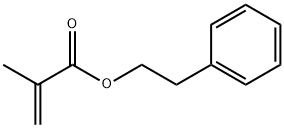
Description
2-Phenylethyl methacrylate serves as a comonomer in free radical copolymerization with 2-phenylethyl acrylate in solution, yielding PEA/PEMA copolymers of varying composition that are studied as soft intraocular lens materials[1]. In ethanolic RAFT dispersion polymerization with poly[2-(dimethylamino)ethyl methacrylate] macro-CTAs, 2-phenylethyl methacrylate acts as a comonomer for producing block copolymer nanoparticles[2].
Uses
2-Phenylethyl methacrylate finds use in perfume compositions, including soap perfumeswhere it may
lend warmth and pleasant “dried-leaf” notes
to a Rose or an Oriental type fragrance. It
blends well with the Methylionones, Cedarwood
products, Jasmin materials, Sandalwood
notes, etc. and it can be used in relatively
large amounts.
Synthesis
2-Phenylethyl methacrylate is prepared by azeotropic esterification of Phenylethylalcohol
with 2-Methylpropenoic acid.
References
[1]
Lee, H., Tae, G., Kim, Y. H. (2008). A study on the copolymerization kinetics of phenylethyl acrylate and phenylethyl methacrylate. Macromolecular Research, 16(7), 614–619.
https://doi.org/10.1007/bf03218569[2] Pei, Y., Dharsana, N. C., Lowe, A. (2015). Ethanolic RAFT Dispersion Polymerization of 2-(Naphthalen-2-yloxy)ethyl Methacrylate and 2-Phenoxyethyl Methacrylate with Poly[2-(dimethylamino)ethyl methacrylate] Macro-Chain Transfer Agents.
Australian Journal of Chemistry,
4 1, 939–945.
https://doi.org/10.1071/CH14490