
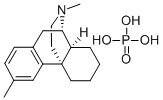
Dimemorfan phosphate
- Product NameDimemorfan phosphate
- CAS36304-84-4
- CBNumberCB9832947
- MFC18H25N.H3O4P
- MW353.396
- EINECS252-958-6
- MDL NumberMFCD01714607
- MOL File36304-84-4.mol
- MSDS FileSDS
Chemical Properties
| Melting point | 267-269° |
| alpha | D23 +25.7° (c = 0.5 in methanol) |
| storage temp. | Store at -20°C |
| solubility | Water : 20 mg/mL (56.59 mM);DMSO : 1 mg/mL (2.83 mM) |
| form | Solid |
| color | White to off-white |
| FDA UNII | S203Y5Y1QP |
Dimemorfan phosphate Price
| Product number | Packaging | Price | Product description | Buy |
|---|---|---|---|---|
| ChemScene CS-7664 | 50mg | $54 | Dimemorfan (phosphate) 99.94% |
Buy |
| ChemScene CS-7664 | 100mg | $81 | Dimemorfan (phosphate) 99.94% |
Buy |
| Biorbyt Ltd orb1221303 | 50mg | $90 | Dimemorfan phosphate >98%(HPLC) |
Buy |
| Biorbyt Ltd orb1302158 | 100mg | $80 | Dimemorfan phosphate 99.91% |
Buy |
| Biorbyt Ltd orb1221303 | 100mg | $130 | Dimemorfan phosphate >98%(HPLC) |
Buy |
Dimemorfan phosphate Chemical Properties,Usage,Production
Preparation
Under nitrogen protection, the starting materials 3-methoxy-17-methyldextralan (5.71 g, 20 mmol) and bis(tricyclohexylphosphine) nickel dichloride (0.70 g, 1 mmol) were added to 100 mL of toluene and stirred until dissolved. The mixture was heated to 65 °C, and methyl magnesium bromide (tetrahydrofuran solution) (1 mol/L, 20 mL, 20 mmol) was added dropwise. After the addition was complete, the mixture was kept at this temperature. TLC was used to detect the complete reaction of the starting materials. The mixture was then cooled to room temperature, and a small amount of saturated ammonium chloride solution was added dropwise to quench the reaction. The mixture was washed with water to separate the layers, and the organic layer was separated. The organic layer was washed with saturated brine, dried, and then distilled under reduced pressure to remove toluene, yielding dimethylphenidate. Without purification, 25 mL of 95% ethanol was added and stirred until dissolved at room temperature. Then, 85% phosphoric acid (2.3 g, 20 mmol) was added, and a white solid precipitated. After filtration, washing, and drying, 5.46 g of Dimemorfan phosphate was obtained, with a yield of 77.4% and a purity of 96.2%.Originator
Astomin,Yamanouchi Pharmaceutical Co., Ltd.Manufacturing Process
Preparation of 1-p-methylbenzyl-1,2,5,6,7,8-hexahydroisoquinoline:a) To a suspension of 2.24 g of a metallic magnesium in 36 ml of an 1:1 mixture of tetrahydrofuran and ether was added dropwise a solution of 13.5 g of p-methylbenzyl chloride in 36 ml of an 1:1 mixture of tetrahydrofuran and ether over a period of about 30 min and then the resultant mixture was refluxed under heating for 30 min. The solution thus obtained was added dropwise to a suspension of 17.5 g of 2-methyl-5,6,7,8-tetrahydroisoquinoline bromide in 90 ml of an 1:1 mixture of tetrahydrofuran and ether cooled to 0- 5°C over a period of about 25 min. After stirring the mixture for 2 hours at temperatures of from 0-5°C, 100 ml of cooled ether and 1.7 N ammonia were added to the reaction product liquid and after shaking sufficiently the system, the ether layer thus formed was recovered. The product in the aqueous layer was further extracted with 50 ml of ether. The ether extract was combined with the ether layer recovered above and then the product in the mixture was extracted 4-times with 30 ml each of 1 N hydrochloric acid cooled. To the hydrochloric acid extract was added 100 ml of cooled 1.7 N ammonia, and the oily material formed was extracted thrice with 80 ml each of ether. After drying the ether extract over anhydrous potassium carbonate, ether was distilled away to provide 15.4 g of oily 1-p-methylbenzyl-1,2,5,6,7,8- hexahydroisoquinoline.
b) In a mixture of 300 ml of methanol and 30 ml of water were dissolved 15.4 g of oily 1-p-methylbenzyl-2-methyl-1,2,5,6,7,8-hexahydroisoquinoline and while stirring the mixture, 2 g of sodium borohydride was added little by little to the mixture at room temperature over a period of about 15 min. After stirring the light yellow solution obtained overnight at room temperature, the solvent was distilled away under a reduced pressure. The residue was mixed with 50 ml of water and 150 ml of ether and after sufficiently shaking the mixture, the ether layer formed was separated. The aqueous layer thus separated was adjusted to basicity by the addition of a small amount of 1.7 N ammonia and then the product in the layer was extracted with 100 ml of ether. The ether layer separated above was combined with the ether extract and after washing the mixture with 1.7 N ammonia and water, the mixture was dried over anhydrous potassium carbonate and then ether was distilled away to provide 13.8 g of an orange oily material. By subjecting the product to a distillation under a reduced pressure, oily D-1-p-methylbenzyl-2-methyl1,2,3,4,5,6,7,8-octahydroisoquinoline was obtained. Boiling point 133- 136°C/0.35 mm Hg.
Preparation of D-3-methyl-N-methylmorphinane:
To 130 ml of 85% phosphoric acid was added 26.5 g of D-1-p-methylbenzyl2-methyl-1,2,3,4,5,6,7,8-octahydroisoquinoline and the mixture was heated to 130-140°C for 72 hours. After the reaction was over, the reaction product liquid was dispersed in ice-water and the solution was made strongly alkaline by the addition of about 300 ml of concentrated aqueous ammonia, whereby an oily material and a crystal were formed. The aqueous solution was mixed with 500 ml of water and 500 ml of ether followed by sufficient shaking; thereafter, the aqueous layer and the ether layer were separated. The aqueous layer was extracted with 500 ml of ether and the extract was combined with the ether layer separated above. Black resinous material floating in the mixture was filtered away. After washing with water the ether solution thus obtained and drying over anhydrous potassium carbonate, 14 g of a black-orange oily material was obtained. When the oily material was immediately distilled under a reduced pressure, 11 g of a faint yellow transparent oily material showing a boiling point of 130-136°C/ 0.3 mm Hg was obtained. The product was crystallized immediately after distillation. The crystals were recrystallized from 12 ml of acetone, recovered by filtration, and washed with 7 ml of acetone to provide 7.3 g of the white prism crystal of D3-methyl-N-methylmorphinane. Furthermore, from the filtrate in the recrystallization were recovered the same crystals. Melting point 90-93°C, [α]D22 = +51.5° (c=1, methanol).
Therapeutic Function
AntitussiveSafety Profile
Poison by intravenous, intraperitoneal, and subcutaneous routes. Moderately toxic by ingestion. An experimental teratogen. Experimental reproductive effects. Used as an antitussive agent. When heated to decomposition it emits very toxic fumes of NOx and POx.Preparation Products And Raw materials
Raw materials
Dimemorfan phosphate Supplier
Global(87)Suppliers
| Supplier | Tel | Country | ProdList | Advantage | |
|---|---|---|---|---|---|
| +86-86-18148706580 +86-18826483838 |
evan@tyvovo.com | China | 140 | 58 | |
| +86-0371-55170693 +86-19937530512 |
info@tianfuchem.com | China | 21533 | 55 | |
| sales@conier.com | China | 49897 | 58 | ||
| +86-0371-86658258 | factory@coreychem.com | China | 29780 | 58 | |
| +1-781-999-5354; +1-00000000000 |
marketing@targetmol.com | United States | 32431 | 58 | |
| +86-29-89586680 +86-15129568250 |
1059@dideu.com | China | 29086 | 58 | |
| 16314854226; +8616314854226 |
inquiry@bocsci.com | United States | 19852 | 58 | |
| +86-18108235634 | Cecilia@youngshechem.com | China | 2345 | 58 | |
| +86-571-87711850 +8619957148339 |
market18@leapchem.com | China | 24569 | 58 | |
| +1-781-999-5354; | support@targetmol.com | United States | 38999 | 58 |
View Latest Prices from Dimemorfan phosphate manufacturers


36304-84-4, Dimemorfan phosphateRelated Search
PROMPT×
PROMPT
The WhatsApp is temporarily not supported in mainland China
The WhatsApp is temporarily not supported in mainland China
Cancel
Determine