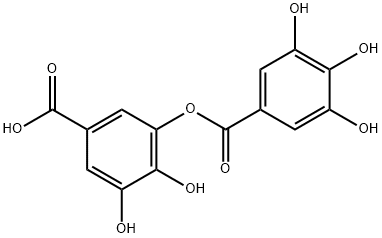
Description
Digallic acid is a natural polyphenolic that can be produced by hydrolysis of gallotannins. Like other polyphenolic compounds, digallic acid has antioxidant activity that can be cytoprotective. Digallic acid inhibits reverse transcriptases from human immunodeficiency virus (K
i = 0.58 μM) and murine leukemia virus. It also inhibits calcium-activated chloride channels, blocking the initial agonist-stimulated chloride current.
Chemical Properties
Off-White Solid
Uses
Digallic Acid is an intermolecular ester of Gallic acid (G188900), a phenolic acid with antioxidant activity. Gallic acid was found to protect human cells against oxidative damage and showed cytotoxicity against cancer cells. Gallic Acid and its esters also show antiviral and antifungal activities.
Definition
ChEBI: Digallic acid is a benzoate ester and a gallate ester. It is functionally related to a gallic acid. It is a conjugate acid of a digallate.
References
[1] WISSEM BHOURI . Study of genotoxic, antigenotoxic and antioxidant activities of the digallic acid isolated from Pistacia lentiscus fruits[J]. Toxicology in Vitro, 2010, 24 2: Pages 509-515. DOI:
10.1016/j.tiv.2009.06.024[2] HIDEO NAKANE Katsuhiko O Masanori Fukushima. Differential Inhibition of Reverse Transcriptase and Various DNA Polymerases by Digallic Acid and Its Derivatives[J]. Journal of Natural Products , 1990, 53 5: 1234-1240. DOI:
10.1021/np50071a015[3] WAN NAMKUNG A S V Puay Wah Phuan. TMEM16A inhibitors reveal TMEM16A as a minor component of calcium-activated chloride channel conductance in airway and intestinal epithelial cells.[J]. The Journal of Biological Chemistry, 2011: 2365-2374. DOI:
10.1074/jbc.m110.175109