Description
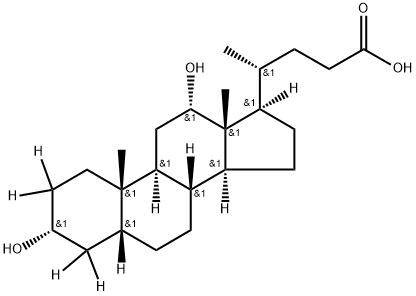
Deoxycholic acid-d
4 (DCA-d
4) is intended for use as an internal standard for the quantification of DCA (Item Nos.
20756 |
18231) by GC- or LC-MS. DCA is a secondary bile acid that is formed
via microbial transformation of cholic acid in the colon. It can be conjugated to glycine or taurine to produce glycodeoxycholic acid (GDCA; ) or taurodeoxycholic acid (TDCA; ), respectively, in hepatocytes. DCA (0.2% v/v) inhibits spore germination induced by taurocholic acid (TCA; ) in seven
C. difficile strains, as well as inhibits growth and decreases the cytotoxicity of
C. difficile culture supernatants to Vero cells when used at a concentration of 0.02% v/v. It inhibits ionizing radiation-induced p53-dependent transcription in a reporter assay using HCT116 cells when used at a concentration of 200 μM. Fecal and intestinal tissue levels of DCA are increased in a rat model of high-fat diet-induced obesity compared with rats fed a normal diet. Increased serum DCA levels have been found in patients with colorectal cancer.
Uses
Deoxycholic-2,2,4,4-d4 Acid (CAS# 112076-61-6) is a useful isotopically labeled research compound.
Definition
ChEBI: Deoxycholic acid-2,2,4,4-d4 is a deuterated compound and a deoxycholic acid.
References
[1] RAJANI THANISSERY Casey M T Jenessa A Winston. Inhibition of spore germination, growth, and toxin activity of clinically relevant C. difficile strains by gut microbiota derived secondary bile acids[J]. Anaerobe, 2017, 45: Pages 86-100. DOI:
10.1016/j.anaerobe.2017.03.004[2] D. QIAO. Deoxycholic acid suppresses p53 by stimulating proteasome-mediated p53 protein degradation.[J]. Carcinogenesis, 2001, 22 6 1: 957-964. DOI:
10.1093/carcin/22.6.957[3] HONG LIN. Alterations of Bile Acids and Gut Microbiota in Obesity Induced by High Fat Diet in Rat Model[J]. Journal of Agricultural and Food Chemistry, 2019, 67 13: 3624-3632. DOI:
10.1021/acs.jafc.9b00249[4] EKKEHARD BAYERDRFFER . Increased serum deoxycholic acid levels in men with colorectal adenomas[J]. Gastroenterology, 1993, 104 1: Pages 145-151. DOI:
10.1016/0016-5085(93)90846-5