Synthesis
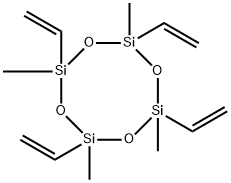
The preparation method of 2,4,6,8-Tetravinyl-2,4,6,8-tetramethylcyclotetrasiloxane includes: (1) adding methylvinyldichlorosilane to a low-temperature solvent system, reacting at low temperature for a period of time, and then raising it to a high-temperature condition for cyclization reaction. After the reaction is completed, the reaction solution is cooled and separated to obtain an acidic water layer and an oil layer; wherein, the solvent system includes water and surfactants; (2) adding salt solution to the oil layer for washing and sedimentation, and adjusting the pH value of the mixture to separate the hydrolysate; (3) performing vacuum distillation on the hydrolysate to obtain a fraction containing 2,4,6,8-Tetravinyl-2,4,6,8-tetramethylcyclotetrasiloxane. Figure: Synthesis reaction formula of 2,4,6,8-Tetravinyl-2,4,6,8-tetramethylcyclotetrasiloxane.
Chemical Properties
Colorless transparent liquid
Physical properties
bp 224–224.5 °C.
Uses
2,4,6,8-Tetramethyl-2,4,6,8-tetravinylcyclotetrasiloxane is used as an intermediate in organic synthesis. It is used in the preparation of 4-vinyl-benzoic acid ethyl ester. Further, it is used to prepare styrene derivatives by cross-coupling with aryl bromide in the presence of palladium catalyst.
Uses
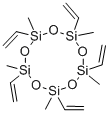
2,4,6,8-Tetraethenyl-2,4,6,8-tetramethylcyclotetrasiloxane (1) (D4V) and the trimer, 2,4,6-triethenyl-2,4,6- trimethylcyclotrisiloxane (2) (D3V) are the two commercially available cyclic polyvinylmethylsiloxanes. D4 V is used as a vinyl donor in the palladium-catalyzed vinylation of aryl halides and as a building block in polymer chemistry and dendrimer synthesis. The palladium-catalyzed vinylation of substituted aryl halides using D4 V is a general and mild method for the preparation of a variety of substituted styrenes or dienes.It is widely used as reagent for the vinylation of aryl halides and building block for
carbosilane dendrimers.
General Description
In the presence of a Pd catalyst, this reagent cross-couples with aryl bromides to give styrene derivatives.
Hazard
Low toxicity by ingestion and inhalation.
Flammability and Explosibility
Non flammable
Purification Methods
A 7mL sample can be distilled in a small Vigreux column (p 11) at atmospheric pressure without polymerisation or decomposition. It is soluble in cyclohexane. [Kantor et al. J Am Chem Soc 77 1685 1955, Beilstein 4 IV 4184.]