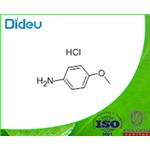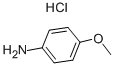
p-Anisidine hydrochloride
- Product Namep-Anisidine hydrochloride
- CAS20265-97-8
- CBNumberCB9282645
- MFC7H10ClNO
- MW159.61
- EINECS243-657-0
- MDL NumberMFCD00036388
- MOL File20265-97-8.mol
- MSDS FileSDS
Chemical Properties
| Melting point | 216-219 °C |
| storage temp. | Store below +30°C. |
| solubility | DMSO (Slightly), Methanol (Slightly) |
| form | Crystalline Powder |
| color | Off-white to pinkish to gray-brown |
| Water Solubility | within almost transparency |
| Stability | Hygroscopic |
| InChI | 1S/C7H9NO.ClH/c1-9-7-4-2-6(8)3-5-7;/h2-5H,8H2,1H3;1H |
| InChIKey | VQYJLACQFYZHCO-UHFFFAOYSA-N |
| SMILES | [Cl-].[N+H3]c1ccc(cc1)OC |
| Toxicology and Carcinogenesis | Bioassay of p-Anisidine Hydrochloride for Possible Carcinogenicity (CASRN 20265-97-8) |
| CAS DataBase Reference | 20265-97-8(CAS DataBase Reference) |
| FDA UNII | 7C4R75N8VG |
| EPA Substance Registry System | p-Anisidine hydrochloride (20265-97-8) |
| UNSPSC Code | 12352107 |
| NACRES | NA.22 |
Safety
| Symbol(GHS) |
 
|
|||||||||
| Signal word | Danger | |||||||||
| Hazard statements | H302+H312-H315-H317-H319-H334-H335 | |||||||||
| Precautionary statements | P261-P280-P301+P312-P302+P352+P312-P304+P340+P312-P305+P351+P338 | |||||||||
| Hazard Codes | T+ | |||||||||
| Risk Statements | 33-26/27/28 | |||||||||
| Safety Statements | 45-36/37/39-28A-1 | |||||||||
| RIDADR | 2811 | |||||||||
| WGK Germany | WGK 3 | |||||||||
| RTECS | BZ6600000 | |||||||||
| TSCA | TSCA listed | |||||||||
| HazardClass | 6.1 | |||||||||
| PackingGroup | III | |||||||||
| HS Code | 29222900 | |||||||||
| Storage Class | 11 - Combustible Solids | |||||||||
| Hazard Classifications | Acute Tox. 4 Dermal Acute Tox. 4 Oral Eye Irrit. 2 Resp. Sens. 1 Skin Irrit. 2 Skin Sens. 1 STOT SE 3 | |||||||||
| Toxicity | mmo-sat 33 mg/plate ENMUDM 7(Suppl 5),1,85 | |||||||||
| NFPA 704: |
|