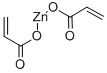
Description
Zincacrylate is a compound that belongs to the class of acrylate polymers, whichare known for their versatile applications in various fields, including biomedicine.In the biomedical field, zinc acrylate is primarily recognized for its use indental materials, drug delivery systems, and tissue engineering. In dental applications, zinc acrylate is often used in dental adhesives and restorative materials dueto its excellent bonding properties and biocompatibility.
Uses
The primary use of Zinc Acrylate is in the production of golf balls. Other uses are primarily in the production of specialty rubber products such as belts and hoses for automobiles. Also used as a tissue adhesive used for adherence of tissue to tissue or tissue to non-tissue for prostheses in vitro.
Preparation
A synthesis method for zinc acrylate/zinc methacrylate includes the following main steps:
(1) Add acrylic acid or methacrylic acid to the reaction vessel, then heat and stir.
(2) When the temperature reaches 40 °C to 80 °C, slowly add zinc oxide while stirring continuously.
(3) When the reaction mixture begins to agglomerate, add the initiator in several portions.
(4) After the initiator has been completely added, continue stirring and maintain the reaction temperature at 60 °C to 120 °C. React for 40 to 80 minutes to form zinc acrylate or zinc methacrylate.
(5) Apply vacuum to reduce the moisture content of the product to ≤ 0.5%.
(6) Crush the solidified product to obtain zinc acrylate/zinc methacrylate powder.
Flammability and Explosibility
Not classified
Materials Uses
Zinc acrylate can be used as a monomer for developing zinc oxide (ZnO) thin films through photopolymerization. ZnO thin films exhibit favorable characteristics for optoelectronic applications, including sensors, light-emitting diodes (LEDs), and photovoltaic cells. By incorporating zinc acrylate, the films gain tunable properties, enhancing their versatility for electronics and photonics applications.
References
[1] CHEN R, LI Y, TANG L, et al. Synthesis of zinc-based acrylate copolymers and their marine antifouling application†[J]. RSC Advances, 2017, 63: 40020-40027. DOI:
10.1039/C7RA04840H.
[2] JIANWEI HOU . Fluorescent zinc acrylate resins containing coumarin structures with enhanced antifouling performance[J]. Progress in Organic Coatings, 2024, 194: Article 108597. DOI:
10.1016/j.porgcoat.2024.108597.
[3] ZHENG WANG . Transparent, hydrophobic, self-polishing organosilicon-modified zinc acrylate polymer coating for marine antifouling[J]. Progress in Organic Coatings, 2025, 201: Article 109143. DOI:
10.1016/j.porgcoat.2025.109143.
[4] WENBIN YAN. Synthesis and characterization of self-crosslinkable zinc polyacrylate latices at room temperature[J]. Iranian Polymer Journal, 2012, 21 9: 631-639. DOI:10.1007/s13726-012-0068-4.