Synthesis
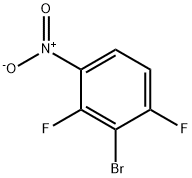
General procedure for the synthesis of 2,4-difluoro-3-bromoaniline from 2-bromo-1,3-difluoro-4-nitrobenzene: A mixture of 2-bromo-1,3-difluoro-4-nitrobenzene (30 g, 130 mmol) and tin (II) chloride dihydrate in 36% hydrochloric acid (150 ml) was heated to 40 °C. Ether (20 ml) was added slowly to form a homogeneous solution. The reaction then proceeded rapidly, accompanied by boiling of the ether. After continued heating at 60°C for 1 hour, the reaction mixture was cooled and subsequently poured into ice water (1.5 liters). The pH of the mixture was adjusted to 13 with a 30% aqueous sodium hydroxide solution, while the internal temperature was controlled below 20°C. The resulting gray slurry was vortex-extracted with chloroform (2 x 500 ml), the organic phases were combined, washed with water and subsequently dried over anhydrous magnesium sulfate containing 2 g of decolorized carbon. After filtration, the solvent was removed by evaporation to give the crude product. Grinding of the crude product with isohexane afforded 23 g (83% yield) of 2,4-difluoro-3-bromoaniline as a light yellow solid. The product was characterized by 1H NMR (360 MHz, CDCl3): δ 3.51 (2H, br), 6.65-6.70 (1H, m), 6.75-6.80 (1H, m).
References
[1] Patent: WO2003/93272, 2003, A1. Location in patent: Page/Page column 38
[2] Journal of Medicinal Chemistry, 2017, vol. 60, # 13, p. 5927 - 5932
[3] Patent: CN108117553, 2018, A. Location in patent: Paragraph 0105; 0106; 0122-0124
[4] Tetrahedron Letters, 2010, vol. 51, # 4, p. 600 - 601
[5] Patent: WO2015/54572, 2015, A1. Location in patent: Page/Page column 279