Synthesis
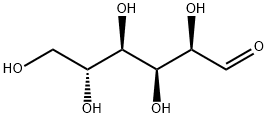
From corn to starch to glucose, modern industry produces glucose on a large scale using enzymatic hydrolysis. The general process of enzymatic hydrolysis is: corn and other grains, peeled and de-embryonated and ground into powder, mixed with water to form a solution. Add saccharase to the solution, the corn starch in the solution will be hydrolyzed, into a glucose solution. The solution is then filtered, concentrated and dried, and we get a shiny white, powdery "glucose monohydrate", molecular formula C6H12O6-H2O. etc. Shiny white powder So the bottle of glucose you get when you go to the clinic for an infusion is glucose monohydrate in water Of course not.
According to the filtration precision, the purity of the finished product and so on, the glucose monohydrate at this time is divided into two grades: food-grade glucose and pharmaceutical-grade glucose. Food to the use of the main is reprocessed into sorbitol, so that sweets and confectionery sweeter and longer shelf life. For medicine, it is used as raw material to produce oral glucose medicine and health products. As for the kind of glucose used in pharmaceutical injections and infusions, it is anhydrous glucose. To get it, we need to further process glucose monohydrate. Roughly the process is: dissolve glucose monohydrate with water, then add activated carbon to further adsorb the heterogeneous color and impurities, and finally heat and evaporate the solvent, and then naturally cooled to precipitate crystals, which are anhydrous glucose (molecular formula C6H12O6).