Chemical Properties
light orange crystalline powder
Uses
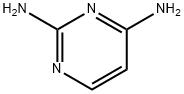
Researchers investigated the corrosion inhibition effect of 2,4-diaminopyrimidine (DAP) in 1.0 mol/L HCl solution on cold-rolled steel using immersion tests, electrochemical tests, and scanning electron microscopy (SEM). The results showed that 2,4-diaminopyrimidine exhibited good corrosion inhibition in HCl solution for cold-rolled steel, and the inhibition rate increased with increasing inhibitor content.
Definition
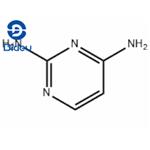
ChEBI: Pyrimidine-2,4-diamine is an aminopyrimidine in which a pyrimidine nucleus is substituted with amino groups at C-2 and C-4.
Synthesis
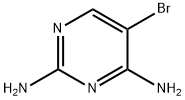
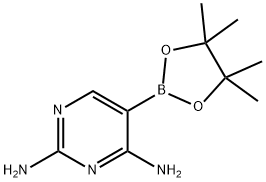
Synthesis of 5-(4,4,5,5-Tetramethyl-1,3,2-dioxaborolan-2-yl)pyrimidine-2,4-diamine: To a dry 1L flask was added 5-bromopyrimidine-2,4-diamine (30.0 g, 158.7 mmol), potassium acetate (45.8 g, 466.7 mmol), pinacol bis(boronic acid) ester (51.16 g, 202.2 mmol) and dioxane (500 mL). After bubbling argon through the solution for 15 minutes, 1,1'-bis(diphenylphosphino)ferrocene palladium(II) chloride (2.53 g, 3.11 mmol) was added. The reaction mixture was refluxed in an oil bath at 115 °C for 16 h under argon protection. After completion of the reaction, it was cooled to room temperature, filtered to remove solid inorganic material and washed with ethyl acetate (1 L). The organic filtrate was concentrated under vacuum and dichloromethane (1 L) was added to the resulting solid. After sonication, the solid was collected by filtration and this solid was the debromination product 2,4-diaminopyrimidine. The filtrate containing the target borate was concentrated in vacuo and ether (100 mL) was added to the residue. After sonication, the filtrate was filtered and washed with additional ether (50 mL), and the resulting solid was dried under high vacuum to afford the target product 2,4-diaminopyrimidine-5-boronic acid pinacol ester (10.13 g, 27% yield). The substance was analyzed by 1H NMR as a 4:1 mixture of 2,4-diaminopyrimidine-5-boronic acid pinacol ester and 2,4-diaminopyrimidine by-product. The mixture could be used in the subsequent Suzuki reaction without further purification.LCMS (m/z): 155 (MH+ of boronic acid, derived from hydrolysis of the in situ product on LC); 1H NMR (CDCl3 + CD3OD): δ8.16 (s, 1H), 1.34 (s, 12H).
References
[1] Patent: WO2008/98058, 2008, A1. Location in patent: Page/Page column 64-65
[2] Patent: WO2007/84786, 2007, A1. Location in patent: Page/Page column 98
[3] ACS Medicinal Chemistry Letters, 2011, vol. 2, # 10, p. 774 - 779
[4] Patent: WO2012/109423, 2012, A1. Location in patent: Page/Page column 23