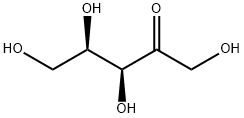
Description
D-Xylulose is a ketopentose, a monosaccharide containing five carbon atoms and a ketone functional group. It is converted from xylitol in the glucoronate-xylulose pathway. D-Xylulokinase catalyzes the ATP-dependent phosphorylation of D-xylulose to produce xylulose 5-phosphate, which is linked to the pentose-phosphate pathway.
Chemical Properties
Clear colorless liquid
Uses
An inducer of ATP catabolism
Uses
D-Xylulose can be used through fermentation to produce ethanol.
Definition
ChEBI: D-xylulose is the D-enantiomer of xylulose. It has a role as a human metabolite, an Escherichia coli metabolite, a Saccharomyces cerevisiae metabolite and a mouse metabolite. It is an enantiomer of a L-xylulose.
References
[1] GABE NAGY Nicola L B P. Monosaccharide Identification as a First Step toward de Novo Carbohydrate Sequencing: Mass Spectrometry Strategy for the Identification and Differentiation of Diastereomeric and Enantiomeric Pentose Isomers[J]. Analytical Chemistry, 2015, 87 8: 4566-4571. DOI:
10.1021/acs.analchem.5b00760[2] RICHARD D BUNKER. Structure and function of human xylulokinase, an enzyme with important roles in carbohydrate metabolism.[J]. The Journal of Biological Chemistry, 2013: 1643-1652. DOI:
10.1074/jbc.m112.427997