Description
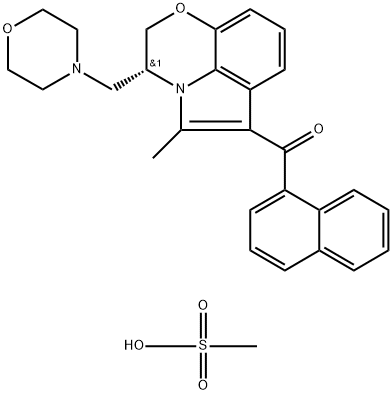
(+)-WIN 55,212-2 (mesylate) is a potent aminoalkylindole cannabinoid (CB) receptor agonist with K
i values of 62.3 and 3.3 nM for human recombinant CB
1 and CB
2 receptors, respectively. In primary cultures of rat cerebral cortex neurons, (+)-WIN 55,212-2 (mesylate) (0.01-100 nM) increases extracellular glutamate levels, displaying a bell-shaped concentration-response curve. This effect is fully counteracted by rimonabant at a concentration of 10 nM, by decreasing Ca
2+ concentrations below 0.2 mM, or by the IP
3 receptor antagonist xestospongin C at a concentration of 1 μM. (+)-WIN 55,212-2 (mesylate) induces release of the proinflammatory neuropeptide CGRP from trigeminal ganglion (TG) neurons in a calcium-dependent manner with an EC
50 value of 26 μM.
Uses
(R)-(+)-WIN 55,212-2 mesylate salt has been used as a high affinity cannabinoid agonist for intraperitoneal injection into rats to induce behavioural sensitization. It has also been used as a synthetic cannabinoid drug and cannabinoid receptor 1 (CNR1) agonist to treat Becn2+/ mice and wild-type (WT) littermate to analyze the levels of CNR1 in the brain.
General Description
WIN 55,212-2 is a member of the aminoalkylindole class of compounds.
Biological Activity
Nanomolar affinity cannabinoid receptor agonist (K i values are 62.3 and 3.3 nM at the human cloned CB 1 and CB 2 receptors respectively). Also available as part of the Cannabinoid Receptor Agonist Tocriset™ .
Biochem/physiol Actions
It is known to decrease the lipopolysaccharide mediated release of tumor necrosis factor- α and interleukin-1 in mice.
References
[1] C C FELDER. Comparison of the pharmacology and signal transduction of the human cannabinoid CB1 and CB2 receptors.[J]. Molecular Pharmacology, 1995, 48 3: 443-450.
[2] U HERZBERG . The analgesic effects of R(+)-WIN 55,212–2 mesylate, a high affinity cannabinoid agonist, in a rat model of neuropathic pain[J]. Neuroscience Letters, 1997, 221 2: Pages 157-160. DOI:
10.1016/s0304-3940(96)13308-5[3] M BOUABOULA. Activation of mitogen-activated protein kinases by stimulation of the central cannabinoid receptor CB1.[J]. Biochemical Journal, 1995, 312 ( Pt 2): 637-641. DOI:
10.1042/bj3120637