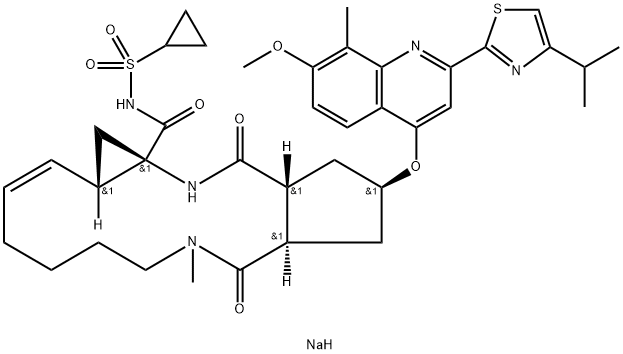
Description
Simeprevir is an orally bioavailable and potent inhibitor of the hepatitis C virus (HCV) nonstructural protein 3/4A (NS3/4A) protease (K
i = 0.36 nM), a serine protease essential for HCV replication. It inhibits HCV viral replication with an EC
50 value of 7.8 nM in Huh7 replicon cells using a luciferase-based assay. Simeprevir is effective against the HCV genotypes 1a and 1b in biochemical assays. In Huh7 replicon cells, it is synergistically effective when used in combination with IFN-α or NM-107 and has an additive effect when used with ribavirin . Formulations containing simeprevir have been used, alone or in combination with pegylated IFN-α and ribavirin, for the treatment of HCV.
Uses
Simeprevir (TMC435; TMC435350) sodium is an oral, potent and highly specific hepatitis C virus (HCV) NS3/4A protease inhibitor with a Ki of 0.36 nM. Simeprevir sodium inhibits HCV replication with an EC50 of 7.8 nM. Simeprevir sodium also potently suppresses SARS-CoV-2 replication and synergizes with Remdesivir. Simeprevir sodium inhibits the main protease (Mpro) and the RNA-dependent RNA polymerase (RdRp) of SARS-CoV-2, and also modulates host immune responses[1][4].
in vivo
Simeprevir (TMC435) has moderate terminal elimination half-life (t1/2=1.5 h and 4.1 h for rat (3 mg/kg, p.o.), monkey (3 mg/kg, p.o.))[3].
Simeprevir (TMC435350) exhibits a medium-slow rate of absorption, well distribution with the high concentration observed in the liver, and a low clearance[1].
Pharmacokinetic Parameters of Simeprevir (TMC435350) in male Sprague-Dawley rats[1].
| IV (2 mg/kg) | PO (10 mg/kg) |
| CL (L/h/kg) | 0.505 | |
| Vdss (h) | 0.49 | |
| AUC0-24 (μM·h) | 5.21 | 2.79 |
| Cmax (μM) | | 0.73 |
| Tmax (h) | | 3.0 |
| T1/2 (h) | | 2.8 |
| F (%) | | 11 |
| Liver/plasma ratio at 6 h | 63.5 | 32 |
| Animal Model: | Sprague-Dawley (SD) rats and cynomolgus monkeys[3] |
| Dosage: | 3 mg/kg |
| Administration: | PO; single dosage |
| Result: | Time at which peak concentration (Tmax) of 1 hour and 2 hour for rat and monkey, respectively.
Concentration at 24 h after dosing (C24 h) of 0.9 and 2.3 ng/mL for rat and monkey, respectively.
AUC0-24h=1173 and 1409 ng·h/mL for rat and monkey, respectively. |
References
[1] Raboisson P, et al. Structure-activity relationship study on a novel series of cyclopentane-containing macrocyclic inhibitors of the hepatitis C virus NS3/4A protease leading to the discovery of TMC435350. Bioorg Med Chem Lett. 2008 Sep 1;18(17):4853-8. DOI:
10.1016/j.bmcl.2008.07.088[2] Lin TI, et al. In vitro activity and preclinical profile of TMC435350, a potent hepatitis C virus protease inhibitor.Antimicrob Agents Chemother. 2009 Apr;53(4):1377-85. Epub 2009 Jan 26. DOI:
10.1128/AAC.01058-08[3] Rajagopalan R, et al. Preclinical Characterization and Human Microdose Pharmacokinetics of ITMN-8187, a Nonmacrocyclic Inhibitor of the Hepatitis C Virus NS3 Protease. Antimicrob Agents Chemother. 2016 Dec 27;61(1). pii: e01569-16. DOI:
10.1128/AAC.01569-16[4] Lo HS, et al. Simeprevir Potently Suppresses SARS-CoV-2 Replication and Synergizes with Remdesivir. ACS Cent Sci. 2021 May 26;7(5):792-802. DOI:
10.1021/acscentsci.0c01186