Synthesis
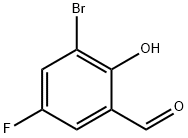
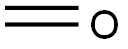
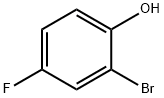
The general procedure for the synthesis of 3-bromo-5-fluoro-2-hydroxybenzaldehyde from formaldehyde and 2-bromo-4-fluorophenol was as follows: to a reaction vial containing MgCl2 (powder, 325 mesh, 5.0 g, 52 mmol, 2 eq.) was added paraformaldehyde (3.0 g, 79 mmol, 3 eq.) and triethylamine (Et3N, 7.0 mL, 52 mmol, 2 eq.) in a THF (60 mL) solution. Subsequently, 2-bromo-4-fluorophenol (5.0 g, 26 mmol, 1 eq.) was added and heated in a microwave reactor at 160 °C for 15 min. The progress of the reaction was monitored by TLC (unfolding agent ratio 3:2 hexane:DCM) to confirm complete consumption of the feedstock. Upon completion of the reaction, THF was removed by evaporation, and the reaction mixture was dissolved in ethyl acetate (EtOAc), washed with brine, dried over anhydrous sodium sulfate, filtered and concentrated in vacuum to afford the crude product 3-bromo-5-fluoro-2-hydroxybenzaldehyde (5.2 g) in 93% yield, which was ready for use in the subsequent steps without further purification.