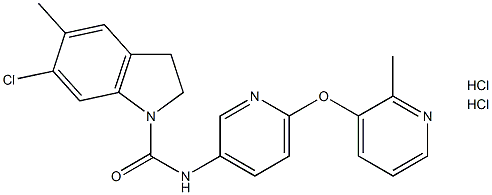
Description
Serotonin (5-
hydroxytryptamine, 5-
HT
) is a neurotransmitter that activates specific receptors located primarily in the gut and central nervous system. SB-242084 is an antagonist of the 5-
HT
2C receptor (pK
i = 9.0), with at least 100-
fold more selectivity over other 5-
HT
, dopamine, or adrenergic receptors.
In vivo, it is brain penetrant and has significant anxiolytic activity, without sedative, proconvulsant, or hyperphagic properties. SB-242084 has been used extensively in animal research to evaluate, for example, 5-
HT
2C receptor agonists and neurotransmitter receptor interactions in mice.
Uses
SB 242084 Hydrochloride is an antagonist of the SR-2C.
Definition
ChEBI: 6-chloro-5-methyl-N-[6-(2-methylpyridin-3-yl)oxypyridin-3-yl]-2,3-dihydroindole-1-carboxamide;dihydrochloride is an organic molecular entity, an indole alkaloid and a pyridine. It has a role as a receptor modulator.
in vivo
SB 242084 dihydrochloride (0.1-1 mg/kg; i.p.; single; 20 min pre-test) improves the behavior of rats in social interaction tests[1].
SB 242084 dihydrochloride (5 mg/kg; i.p.; single; 20 min pre-test) improves mCPP-induced hypophagia in rats[1].
SB 242084 dihydrochloride (5, 10 mg/kg; i.p.; single) increases the levels of basal dialysate dopamine (DA) and dihydroxyphenylacetic acid (DOPAC) in the nucleus accumbens of rats[3].
SB 242084 dihydrochloride (160-640 μg/kg; i.v.; single) dose-dependently and significantly increases the basal firing rate of VTA (ventral tegmental area) dopaminergic neurons, and the bursting activity is also enhanced in the same area, in vivo[3].
| Animal Model: | Male Sprague-Dawley (CD) rats[1]. |
| Dosage: | 0.1-1 mg/kg |
| Administration: | Intraperitoneal injection; single; 20 min pre-test |
| Result: | Significantly increased the amount of time rats spent in social interaction over 15 min under brightly lit conditions and in an unfamiliartest box. |
| Animal Model: | Male Sprague-Dawley (CD) rats(mCPP-induced hypophagia model)[1]. |
| Dosage: | 5 mg/kg |
| Administration: | Intraperitoneal injection; single; 20 min pre-test |
| Result: | Significantly reduced the amount of food consumed by 23 h food-deprivedrats over a 1hr test period from the time of food presentation. |
| Animal Model: | Rats[2]. |
| Dosage: | 5, 10 mg/kg |
| Administration: | Intraperitoneal injection; single |
| Result: | Significantly increased basal dialysate dopamine (DA) and dihydroxyphenylacetic acid (DOPAC) in the nucleus accumbens. |
IC 50
5-HT
2C Receptor: 9.0 (pKi)
storage
Desiccate at +4°C
References
[1] G.A. KENNETT . SB 242084, a Selective and Brain Penetrant 5-HT2C Receptor Antagonist[J]. Neuropharmacology, 1997, 36 4: Pages 609-620. DOI:
10.1016/s0028-3908(97)00038-5[2] STEVEN M. BROMIDGE. 6-Chloro-5-methyl-1-[[2-[(2-methyl-3- pyridyl)oxy]-5-pyridyl]carbamoyl]indoline (SB-242084): The First Selective and Brain Penetrant 5-HT2C Receptor Antagonist[J]. Journal of Medicinal Chemistry, 1997, 40 22: 3494-3496. DOI:
10.1021/jm970424c[3] PAUL J FLETCHER Guy A H Judy Sinyard. The effects of the 5-HT(2C) receptor antagonist SB242084 on locomotor activity induced by selective, or mixed, indirect serotonergic and dopaminergic agonists.[J]. Psychopharmacology, 2006, 187 4: 515-525. DOI:
10.1007/s00213-006-0453-9[4] G L DALTON. Serotonin 1B and 2C receptor interactions in the modulation of feeding behaviour in the mouse.[J]. Psychopharmacology, 2006, 185 1: 45-57. DOI:
10.1007/s00213-005-0212-3[5] JIANPING CHEN, JIA ZHOU* Discovery of Novel Oleamide Analogues as Brain-Penetrant Positive Allosteric Serotonin 5-HT2C Receptor and Dual 5-HT2C/5-HT2A Receptor Modulators[J]. Journal of Medicinal Chemistry, 2023, 66 14: 9992-10009. DOI:
10.1021/acs.jmedchem.3c00908