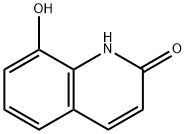
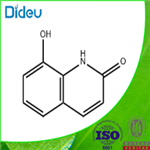
Synthesis
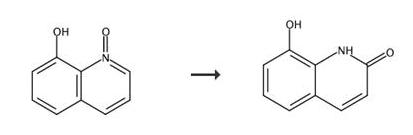
solution of quinoline-8-ol-1-oxide (20 g, 124 mmol) in acetic anhydride (200 mL) was stirred at 90°C for 5 hours. The reaction mixture was then poured into a water/ice mixture (1.5 L) and neutralized by adding conc. aq. The precipitate formed was collected by filtration and washed with water. The crude product was suspended in propanol and purified by adding petroleum ether to give 2-oxo-1,2-dihydroquinoline-8-acetate. 2-oxo-1,2-dihydroquinoline-8-acetate was heated in a concentrated solution. aq. Soaked in hydrochloric acid (200 mL) at 90°C for 4 hours. The reaction mixture was poured into ice water (400 mL), and the precipitate formed was collected by filtration and washed with water. Recrystallization from propane-2-ol/petroleum ether gave the target compound 2,8-quinolinediol (14.1 g, 70%).
Chemical Properties
Brown Powder
Uses
2,8-Quinolinediol is suitable for use as standard in a study to identify the urinary metabolites for the toxicity related processes and pathogenesis induced by doxorubicin (DOX) to rats by online and off-line LC-MS techniques. It may be used as starting reagent for the preparation of two powerful β2-adrenergic receptor agonists, used for the treatment of asthma:
Uses
2,8-Quinolinediol is a substituted quinolinone derivative used in the preparation of pharmaceutical compounds.
Definition
ChEBI: Quinoline-2,8-diol is a dihydroxyquinoline. It is a tautomer of an 8-hydroxyquinolin-2(1H)-one.
General Description
2,8-Quinolinediol is a quinolone derivative. It has been reported as metabolite of 8-hydroxyquinoline-
N-oxide in rabbits. Synthesis of 2,8-quinolinediol has been reported. It is reported as one of the six possible forms of 8-hydroxycarbostyril. It has been detected as new UV-absorbing compound (UAC) in cow milk and its structure was elucidated using HRMS and by
1H,
13C and
1H ×
13C NMR.It is also known as 8-hydroxycarbostyril or 8-hydroxyquinolin-2(1
H)-one.