Preparation
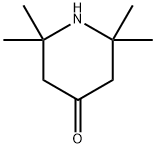
Step 1: Add tetramethylpiperidinone, catalyst, caustic soda flakes, and water to the high-pressure reactor and seal it.
Step 2: Purge the reactor with N2 to replace the air, then purge with H2 to replace the N2, and finally purge with H2 until the pressure reaches 0.8 MPa.
Step 3: First, maintain the pressure inside the reactor at 0.8 MPa. When the pressure drops, promptly replenish the reactor with H2 to 0.8 MPa while stirring and heating, controlling the temperature at 70-100°C. Repeat the above operation until the pressure inside the reactor remains at 0.8 MPa for a certain period of time without change, then stop the reaction.
Step 4: Purge the reactor with N2 to replace the H2, and simultaneously purge the reactor coils with cooling water to lower the temperature inside the reactor to below 50°C. Stop stirring, filter out the catalyst, and distill off some of the water.
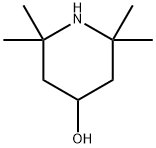
Step 5: Stir and cool the remaining supersaturated mother liquor in an ice-water bath to crystallize, filter and wash to obtain 2,2,6,6-Tetramethyl-4-piperidinol, and recover and reuse the mother liquor.
Uses
2,2,6,6-tetramethyl-4-piperidinol has been used to study the irradiation of Camptothecin (CPT) in aerated dimethylsulfoxide (DMSO) solution that leads to formation of singlet oxygen.
Purification Methods
The piperidine crystallises from water as a hydrate and crystallises from dry ether or *C6H6 as the anhydrous base. The hydrochloride has m 282-284o (from EtOH/H2O), and the formate has m 207o(dec, from EtOH/EtOAc). [Mailey & Day J Org Chem 22 1061 1957, Beilstein 21 I 195, 21 III/IV 146, 21/1 V 159.]