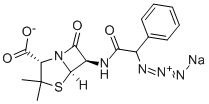
Uses
Azidocillin sodium, a semi-synthetic Penicillin, is an orally active β-lactam antibiotic. Azidocillin sodium bears an azide functionality and retains on-target activity within bacteria. Azidocillin sodium can be used to research osteitis caused by dental surgery, otitis media, enterococcal septicemia and other bacterial infectious diseases[1][2][3]. Azidocillin sodium is a click chemistry reagent, it contains an Azide group and can undergo copper-catalyzed azide-alkyne cycloaddition reaction (CuAAc) with molecules containing Alkyne groups. It can also undergo strain-promoted alkyne-azide cycloaddition (SPAAC) reactions with molecules containing DBCO or BCN groups.
Definition
ChEBI: Azidocillin sodium is an organic sodium salt. It contains an azidocillin(1-).
References
[1] Bystedt H, et al. Concentration of azidocillin, erythromycin, doxycycline and clindamycin in dental alveolar serum after single oral doses. Int J Oral Surg. 1977 Apr;6(2):65-74. DOI:
10.1016/s0300-9785(77)80001-x[2] Spangler B, et al. Molecular Probes for the Determination of Subcellular Compound Exposure Profiles in Gram-Negative Bacteria. ACS Infect Dis. 2018 Sep 14;4(9):1355-1367. DOI:
10.1021/acsinfecdis.8b00093[3] Bengtsson E, et al. Azidocillin treatment of enterococcal septicemia. Scand J Infect Dis. 1972;4(2):143-8. DOI:
10.3109/inf.1972.4.issue-2.15