Description
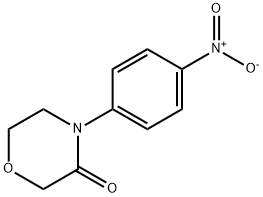
4-(4-Nitrophenyl)morpholin-3-one is a nitro compound that has been shown to be magnetic and show an operational chemical formula. It has been studied in techniques such as magnetic resonance imaging (MRI) and X-ray crystallography.
Chemical Properties
Yellow Solid
Uses
Reagent used in the preparation of various Morpholine based pharmaceuticals. Rivaroxaban Impurity 52.
Uses
4-(4-Nitrophenyl)morpholin-3-one is a reagent used in the preparation of various Morpholine based pharmaceuticals.
Application
4-(4-Nitrophenyl)morpholin-3-one has also been used to synthesize nanowires, which are thin wires of semiconducting material that have a diameter of less than one micrometer. The synthesis can be done by pegylation, which attaches polyethylene glycol molecules to the molecule's surface. This technique is often used in biomedical applications because it prevents the molecule from being degraded by enzymes in the body.
Synthesis
The synthesis of 4-(4-nitrophenyl)morpholin-3-one was carried out by two steps of synthesis as shown in figure below.
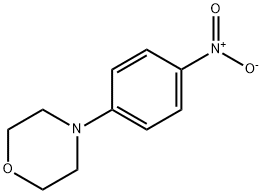
[1]Step 1: Finely ground potassium permanganate (0.474 g, 3.00 mmol) was added to a stirred solution of the 4-phenylmorpholine (0.326 g, 2.00 mmol) and benzyltrimethylammoniun chloride (0.683 g, 3.00 mmol) in dichloromethane (10 mL), and the purple solution was stirred at reflux for 3 h. The mixture was cooled in ice and a solution of sodium bisulfite (2 g) in water (10 mL) was added and separated; the aqueous phase was extracted with chloroform (3 × 10 mL). The combined organic extract was washed with water (20 mL) and dried with Na2SO4. The solvent removal gave a residual yellow solid (0.205 g, 56% yield) which was recrystallized from hexane to give 4-phenylmorpholin-3-one (0.135 g, 35% yield).
Step 2: To a solution of 4-phenylmorpholin-3-one (0.995 g, 5.62 mol) at 98%, H2SO4 (2.33 mL) cooled to −10 °C 65% HNO3 was carefully added dropwise (0.4 mL) over 45 min. The reddish solution obtained was stirred at this temperature for 1 h and H2O (5 mL) was added. The mixture was neutralized with 35% NH4OH until pH 7. The resulting precipitate was filtered, washed with cold water and dried, resulting in 4-(4-Nitrophenyl)morpholin-3-one (1.01 g, 83% yield) as a brown solid.

References
[1] Shanmugaraj, K., Bustamante, T. M., Campos, C. H., & Torres, C. C. (2020). Liquid Phase Hydrogenation of Pharmaceutical Interest Nitroarenes over Gold-Supported Alumina Nanowires Catalysts. Materials, 13(4), 925.
https://doi.org/10.3390/ma13040925