Chemical Properties
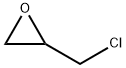
Epichlorhydrin is a colourless liquid with
odour, b.p. 115°C.
Chemical Properties
Colorless to light yellow liqui
Uses
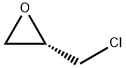
(S)-(+)-Epichlorohydrin is utilized for the synthesis of macquarimicins and hydroxyisoxazolidines and (+)-cis-sylvaticin, which is a potential antitumor agent. It is used to synthesize inhibitors of fatty acid oxidation as potential metabolic modulators. It acts as a solvent for natural and synthetic resins, gums, cellulose esters and ethers, paints, varnishes, nail enamels, lacquers and cement for celluloid. It is also used as a stabilizer and also useful as a bifunctional alkylating agent with the potential to form DNA cross-links.
Uses
S-enantiomer of Epichlorohydrin, (S)-Epichlorohydrin), an important industrial chemical, is a bifunctional alkylating agent with the potential to form DNA cross-links. It is used as a solvent for natural and synthetic resins, gums, cellulose esters and ethers, paints, varnishes, nail enamels and lacquers, cement for Celluloid. Also, it is used as stabilizer.
Production Methods
Chiral epichlorohydrin (ECH) is an attractive intermediate for chiral pharmaceuticals and chemicals preparation. The asymmetric synthesis of chiral ECH using 1,3-dicholoro-2-propanol (1,3-DCP) catalyzed by a haloalcohol dehalogenase (HHDH) was considered as a feasible approach
[6].
Definition
ChEBI: (S)-epichlorohydrin is an epichlorohydrin. It is functionally related to a (R)-1,2-epoxypropane. It is an enantiomer of a (R)-epichlorohydrin.
Synthesis
The general procedure for the synthesis of (S)-(+)-epichlorohydrin from 1-chloro-2,3-epoxypropane is as follows: first, 463 kg of racemic epichlorohydrin was mixed with 19.2 kg of the catalyst [(1-RR)-(dibenzoyl-LLA)] made from Example 1 of the Preparation and the mixture was cooled to 5 °C. Subsequently, 49.5 kg of water was slowly added and the reaction continued at 20°C for 7 hours. Upon completion of the reaction, the reaction mixture was subjected to reduced-pressure thin-film evaporation at less than 30 °C to afford 190 kg of (S)-epichlorohydrin with an optical purity of 99.8% ee and a yield of 82%. The above reaction process was repeated by adding new racemic epichlorohydrin and water to the evaporated residue to again obtain (S)-epichlorohydrin with an optical purity of more than 99.0%ee.
References
[1] Patent: WO2008/153280, 2008, A1. Location in patent: Page/Page column 41
[2] Patent: WO2008/153280, 2008, A1. Location in patent: Page/Page column 28
[3] Tetrahedron Asymmetry, 2003, vol. 14, # 22, p. 3633 - 3638
[4] Journal of the American Chemical Society, 1995, vol. 117, # 21, p. 5897 - 5898
[5] Journal of the American Chemical Society, 1999, vol. 121, # 17, p. 4147 - 4154
[6] Zhang, X.-J., Huang, M.-Y., Peng, X.-X., Cao, M., Deng, H.-Z., Gong, Y.-C., Tang, X.-L., Liu, Z.-Q., & Zheng, Y.-G. (2024). Preparation of (S)-epichlorohydrin using a novel halohydrin dehalogenase by selective conformation adjustment. Biotechnology Letters, 699–711.
https://doi.org/10.1007/s10529-024-03479-y