Uses
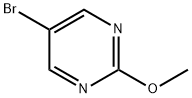
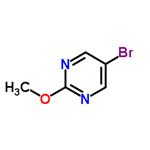
5-Bromo-2-methoxypyrimidine serves as a precursor in Suzuki coupling reactions with methyl-2-{(1R,4R)-4-[4-(4,4,5,5-tetramethyl-1,3,2-dioxaborolan-2-yl)phenyl]cyclohexyl}acetate and sodium carbonate to synthesize a kind of phenylcyclohexylacetic acids[3]. The compound reacts with Bu3SnH and V-65 to produce 5-deutero-2-methoxypyrimidine via a deuteration protocol[4].
Synthesis
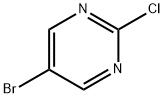
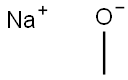
Synthesis of compound 11-3 (5-bromo-2-methoxypyrimidine): to a solution of 5-bromo-2-chloropyrimidine (11-2, 2.0 g, 10 mmol) in methanol (15 mL) was added sodium methanolate (CH3ONa, 2.16 g, 40 mmol). The reaction mixture was stirred at 70 °C overnight. Upon completion of the reaction, methanol was removed by rotary evaporator under reduced pressure. Water (10 mL) was slowly added to the residue, followed by extraction with ethyl acetate (300 mL x 3). The organic phases were combined, dried over anhydrous sodium sulfate (Na2SO4), filtered and concentrated to give 11-3 as a yellow solid (1.17 g, 60% yield).
References
[1] Patent: US9138427, 2015, B2. Location in patent: Page/Page column 289-290
[2] Bioorganic and Medicinal Chemistry Letters, 2011, vol. 21, # 19, p. 5849 - 5853
[3]Fan, J., de Jonge, B. L. M., MacCormack, K., Sriram, S., McLaughlin, R. E., Plant, H., Preston, M., Fleming, P. R., Albert, R., Foulk, M., & Mills, S. D. (2014). A Novel High-Throughput Cell-Based Assay Aimed at Identifying Inhibitors of DNA Metabolism in Bacteria. Antimicrobial Agents and Chemotherapy, 58(12), 7264–7272.
https://doi.org/10.1128/aac.03475-14 [4]Mutsumi, T., Iwata, H., Maruhashi, K., Monguchi, Y., & Sajiki, H. (2011). Halogen–deuterium exchange reaction mediated by tributyltin hydride using THF-d8 as the deuterium source. Tetrahedron, 67(6), 1158–1165.
https://doi.org/10.1016/j.tet.2010.12.007