Description
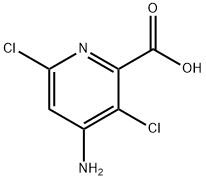
Aminopyralid is a pyridine carboxylic acid herbicide. It is non-volatile, highly soluble in water and, based on its chemical properties, is mobile and has a high potential for leaching to groundwater. It may be moderately persistent in soil systems but would not be expected to persistent in surface water under normal conditions. It has a low mammalian toxicity and there is some concern regarding its potential for bioaccumulation. Aminopyralid has a low to moderate toxicity to most terrestrial and aquatic species.
Definition
ChEBI: An organochlorine pesticide having a 3,6-dichlorinated 4-aminopicolinic acid structure.
Flammability and Explosibility
Non flammable
Agricultural Uses
Herbicide: A systemic, post-emergence herbicide for industrial vegetation and pastures. Used to control woody
plants, clovers, and thistles. This herbicide is absorbed by roots and leaves. Not listed for use in EU
countries.
Trade name
BANISH®; FOREFRONT®; HALCYON®;
MILESTONE® VM; PHARAOH®; PRO-BANISH®;
RUNWAY®; SYNERO®; UPFRONT®
Mechanism of action
Systemic, absorbed by leaves and roots, some residual action. It disrupts plant growth metabolic pathways, causing uncontrolled cell division and abnormal growth.
Synthesis
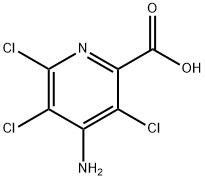
General procedure for the synthesis of 4-amino-3,6-dichloropyridine-2-carboxylic acid from 4-amino-3,5,6-trichloropyridine-2-carboxylic acid: 50.8 g of 4-amino-3,5,6-trichloropyridine-2-carboxylic acid was mixed with 500 ml of water, and 66.7 g of 30% sodium hydroxide solution was added homogeneously, and then after filtration the filtrate was transferred to a 1000 ml high-pressure reactor fitted with a magnetic stirrer, a thermometer, and an exhaust pipe. After filtration, the filtrate was transferred to a 1000-mL high-pressure reactor equipped with a magnetic stirrer, thermometer and exhaust pipe. 2 g of 5% Pd/C catalyst was added to the reactor, the reactor was sealed, replaced with nitrogen three times, and then filled with hydrogen to a pressure of 0.2 MPa. Stirring was initiated and the temperature was raised to 50°C, and the pressure was further increased to 0.3 MPa by filling with hydrogen, and the reaction was confirmed to be complete by HPLC after 20 hours, and then cooled down to room temperature. The reaction solution was decanted out, filtered to recover the catalyst, and the filtrate was adjusted to pH 1-2 with 30% hydrochloric acid, cooled to crystallize and centrifuged, and the precipitate was washed with hot water to obtain 38.8 g of 4-amino-3,6-dichloro-pyridine-2-carboxylic acid, with the product purity of 97.5% and the yield of 91.4%.
References
[1] Patent: CN105461622, 2016, A. Location in patent: Paragraph 0024-0027
[2] Patent: WO2008/42429, 2008, A1. Location in patent: Page/Page column 9-10
[3] Patent: WO2008/42429, 2008, A1. Location in patent: Page/Page column 10-11; 11-12