Description
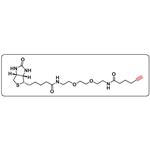
Alkynyl-biotin is a form of biotin with a terminal alkyne group separated by two polyethylene glycol moieties. It is used to add biotin to other molecules bearing an azide group using a copper Cu(I)-catalyzed azide-alkyne cycloaddition reaction. Alkynyl-biotin has been used to add a biotin tag to a range of biochemicals, amino acids, proteins, and nucleotides that have been modified by the addition of an azide group. Alkynyl-biotin can also be used to capture sulfenic acid-modified proteins that have been tagged with the cell-permeable probe DAz-2 .
Uses
Biotin-PEG2-C4-alkyne is a PEG-based PROTAC linker can be used in the synthesis of PROTACs. Biotin-PEG2-C4-alkyne is a click chemistry reagent, it contains an Alkyne group and can undergo copper-catalyzed azide-alkyne cycloaddition (CuAAc) with molecules containing Azide groups.
References
[1] DANIEL B. MCCLATCHY, *. Pulsed Azidohomoalanine Labeling in Mammals (PALM) Detects Changes in Liver-Specific LKB1 Knockout Mice[J]. Journal of Proteome Research, 2015, 14 11: 4815-4822. DOI:
10.1021/acs.jproteome.5b00653[2] PENG WU. A high-throughput-compatible assay to measure the degradation of endogenous Huntingtin proteins[J]. Acta Pharmacologica Sinica, 2016, 37 10: 1307-1314. DOI:
10.1038/aps.2016.31[3] JESSICA ZAYAS. Strain Promoted Click Chemistry of 2- or 8-Azidopurine and 5-Azidopyrimidine Nucleosides and 8-Azidoadenosine Triphosphate with Cyclooctynes. Application to Living Cell Fluorescent Imaging[J]. Bioconjugate Chemistry Bioconjugate, 2015, 26 8: 1519-1532. DOI:
10.1021/acs.bioconjchem.5b00300[4] STEPHEN E. LEONARD Kate S C Khalilah G Reddie. Mining the Thiol Proteome for Sulfenic Acid Modifications Reveals New Targets for Oxidation in Cells[J]. ACS Chemical Biology, 2009, 4 9: 783-799. DOI:
10.1021/cb900105q