Preparation
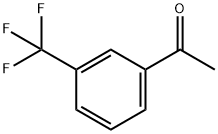
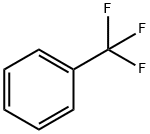
3'-(Trifluoromethyl)acetophenone is an important organic synthetic intermediate, mainly used in pharmaceuticals, pesticides, and dyes. Laboratory synthesis methods include: 1. Grignard reaction of m-trifluoromethylbenzyl cyanide with iodomethane. 2. Grignard reaction of m-trifluoromethylbenzoic acid after acylation with iodomethane. 3. Reaction of m-trifluoromethylbenzaldehyde with diazomethane. 4. Reaction of m-trifluoromethylaniline diazonium salt with acetaldehyde. 5. Reaction of m-trifluoromethylbromobenzene with Grignard reagent and acetic anhydride (using trifluoromethylbenzene as a starting material, after bromination, Grignard reaction, and reaction with acetic anhydride to synthesize 3'-(Trifluoromethyl)acetophenone, with an overall yield of 40%). Methods 1, 2, and 3 have expensive starting materials, are difficult to source, have low yields, are dangerous, and are not easily industrialized. Method 5 is easily industrialized, but the nitrogen yield is too low, only about 40%. Yancheng Fluorine Source Chemical Co., Ltd. has developed a new method to synthesize 3'-(Trifluoromethyl)acetophenone from m-trifluoromethylaniline through diazotization, coupling, and hydrolysis, with a total yield of 78%.
General Description
Asymmetric catalytic addition of ethyl groups to 3′-(trifluoromethyl)acetophenone catalyzed by ligands derived from
trans-1,2-diaminocyclohexane and camphor sulfonyl chloride has been reported. Phenylation of 3′-(trifluoromethyl)acetophenone in the presence of dihydroxy
bis(sulfonamide) ligand (enantioselective catalyst), titanium tetraisopropoxide and diphenylzinc has been investigated.