Synthesis
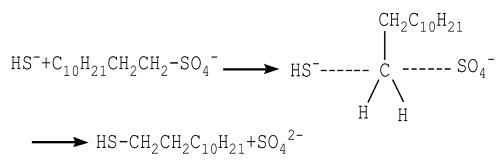
Sodium monoalkyl sulfate replaces haloalkanes in the reaction with sodium hydrosulfide to prepare 1-Tetradecanethiol. The thiolation of straight-chain alkyl sulfates is generally considered a nucleophilic substitution reaction at the α-position. The nucleophile hydrosulfate ion attacks the α-carbon atom from the back of the leaving group sulfate ion. Due to the electron-donating effect of the leaving group, the α-carbon atom has weak electrophilicity, and the reaction proceeds via an SN 2 mechanism. The reaction mechanism for the synthesis of 1-Tetradecanethiol is shown in the figure below:
Chemical Properties
Colorless liquid
Uses
TDT is used as a self-assembled monolayer (SAM) on gold nanoparticle(AuNP) based electrodes for bi-enzymer glucose biosensors. The surface modification was done by soaking the electrodes in TDT solution.
General Description
1-Tetradecanethiol (TDT) is an alkanethiol used as a self-assembled monolayer (SAM) which may be used to functionalize a variety of nanoparticles. It is a hydrophobic ligand. It is highly oriented and acts as a hole-injection barrier on the nanoparticle surface.