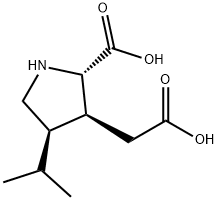
Description
Dihydrokainic acid (DHK) is an inhibitor of excitatory amino acid transporter 2 (EAAT2; K
i = 23 μM for glutamate uptake by COS cells expressing EAAT2). It is selective for EEAT2 over EAAT1 and EAAT3 (K
i = >3 mM for both). DHK microinfusion (5 nmol) into the rat infralimbic cortex reduces the time spent immobile in the forced swim test, indicating antidepressant-like behavior, an effect that is blocked by the AMPA receptor antagonist NBQX and the serotonin (5-HT) receptor subtype 5-HT
1A antagonist WAY-100635 . It also increases glutamate and serotonin levels and the expression of c-Fos in the dorsal raphe nucleus. In contrast, DHK microinjection (6.25 nmol) into the rat prefrontal cortex (PFC) increases the latency to drink sucrose in a sucrose intake test, indicating anhedonia-like behavior. It also impairs memory acquisition, consolidation, and retrieval in mice in the novel object recognition test.
Uses
Dihydrokainic acid has been used as a glutamate transporter (GLT-1) inhibitor in the glutamate uptake assay of astrocytes and glial cells. It may be used as a GLT-1 inhibitor in Lateral habenula (LHb).
Definition
ChEBI: Dihydrokainic acid is a dicarboxylic acid. It is functionally related to a kainic acid.
Biological Activity
EAAT2(GLT1)-selective non-transportable inhibitor of L-glutamate and L-aspartate uptake (K i = 23 μ M). 130-fold selective over EAAT1 and EAAT3 (K i > 3 mM). Also available as part of the Excitatory Amino Acid Transporter Inhibitor Tocriset™ .
Biochem/physiol Actions
Dihydrokainic favors neuronal cell death. It modulates anxiety and depression behaviors.
References
[1] J. ARRIZA. Functional comparisons of three glutamate transporter subtypes cloned from human motor cortex[J]. Journal of Neuroscience, 1994, 42 1: 5559-5569. DOI:
10.1523/jneurosci.14-09-05559.1994[2] J GASULL-CAMóS. Glial GLT-1 blockade in infralimbic cortex as a new strategy to evoke rapid antidepressant-like effects in rats[J]. Translational Psychiatry, 2017, 7 2: e1038-e1038. DOI:
10.1038/tp.2017.7[3] JúLIA GASULL-CAMóS . Serotonergic mechanisms involved in antidepressant-like responses evoked by GLT-1 blockade in rat infralimbic cortex[J]. Neuropharmacology, 2018, 139: Pages 41-51. DOI:
10.1016/j.neuropharm.2018.06.029[4] CATHERINE S JOHN. Blockade of Astrocytic Glutamate Uptake in the Prefrontal Cortex Induces Anhedonia[J]. Neuropsychopharmacology, 2012, 37 11: 2467-2475. DOI:
10.1038/npp.2012.105[5] SHAO-WEN TIAN . Glutamate transporter GLT1 inhibitor dihydrokainic acid impairs novel object recognition memory performance in mice[J]. Physiology & Behavior, 2019, 199: Pages 28-32. DOI:
10.1016/j.physbeh.2018.10.019