Description
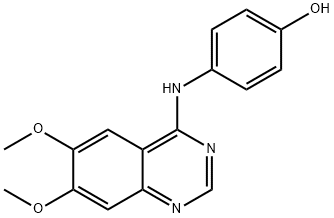
WHI-P131 (202475-60-3) is a JAK3 inhibitor.Inhibits human glioblastoma cell adhesion and invasion.1 Increases survival in a mouse ALS model.2 Delays or prevents autoimmune type 1 diabetes in NOD mice.3 Exhibits potent anti-inflammatory activity in mouse models of peritonitis, colitis, cellulitis and systemic inflammatory response syndrome.4 Displays protective effects against myocardial ischemia and reperfusion injury in mouse models.5
Uses
Janex 1 is a Janus tyrosine kinase 3 (JAK3) inhibitor. Inhibition of JAK3 has been shown to exhibit protective action against the development of T1D in non-obese diabetic (NOD) mice. Janex 1 has been shown to suppresses proliferation of short-term cultured NOD CD4+ T cells through induction of apoptosis, while promoting survival of a particular population of long-term cultured cells. It ameliorates the expression of TNF-α-induced cell adhesion molecules and improves myocardial vascular permeability.
in vivo
JANEX-1 is administered at doses ranging from 5 to 100 mg/kg. Evaluation of CPK activity revealed a dose-response curve with an effective dose 50 (ED50) value of 7.44 mg/kg. Mice receiving JANEX-1 displayed significantly reduced CPK and LDH levels. In addition, the infarct size of JANEX-1-treated mice (30.16±2.79%) is significantly decreased when compared with I/R-operated mice (65.64±3.76%)[2]. JANEX-1 (WHI-P131) is absorbed rapidly, and the time to reach the maximum plasma JANEX-1 concentration (tmax) is 24.7±1.7 min. JANEX-1 is rapidly eliminated with an elimination half-life of 45.6±5.5 min. Although the predicted maximum plasma JANEX-1 concentration is 10.5 ± 0.8 μM, which is only half of the Cmax following i.v. administration of the same bolus dose, the i.p. bioavailability is 94.6% and the systemic exposure levels (i.e., AUC) are very similar to those observed after i.v. injection (17.1±2.2 μM h versus 18.1±1.2 μM h)[3].
Background
WHI-P131 is a potent and selective inhibitor of Janus kinase 3 and glioblastoma cell adhesion and migration. This novel quinazoline derivative inhibits the enzymatic activity of constitutively active Jak3 without affecting Jak1, Jak2, or other family tyrosine kinases. WHI-P131 has also been shown to inhibit thrombin-induced tyrosine phosphorylation of Stat1 and Stat3. These properties make this compound useful when studying different diseases such as acute lymphoblastic leukemia, glioblastoma multiforme, and thromboembolism.
References
[1] R K NARLA. Inhibition of human glioblastoma cell adhesion and invasion by 4-(4’-hydroxylphenyl)-amino-6,7-dimethoxyquinazoline (WHI-P131) and 4-(3’-bromo-4’-hydroxylphenyl)-amino-6,7-dimethoxyquinazoline (WHI-P154).[J]. Clinical Cancer Research, 1998, 4 10: 2463-2471.
[2] VUONG N. TRIEU . A Specific Inhibitor of Janus Kinase-3 Increases Survival in a Transgenic Mouse Model of Amyotrophic Lateral Sclerosis[J]. Biochemical and biophysical research communications, 2000, 267 1: Pages 22-25. DOI:
10.1006/bbrc.1999.1905[3] MARINA CETKOVIC-CVRLJE . Targeting JAK3 with JANEX-1 for prevention of autoimmune type 1 diabetes in NOD mice[J]. Clinical immunology, 2003, 106 3: Pages 213-225. DOI:
10.1016/s1521-6616(02)00049-9[4] FATIH M. UCKUN . Anti-inflammatory activity profile of JANEX-1 in preclinical animal models[J]. Bioorganic & Medicinal Chemistry, 2008, 16 3: Pages 1287-1298. DOI:
10.1016/j.bmc.2007.10.066[5] YOUNG-BIN OH. Inhibition of Janus activated kinase-3 protects against myocardial ischemia and reperfusion injury in mice[J]. Experimental and Molecular Medicine, 2013, 45 5: e23-e23. DOI:
10.1038/emm.2013.43