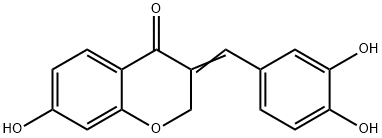
Description
Sappanone A is a homoisoflavonoid with diverse biological activities that has been isolated from the aerial parts of
C. pulcherrima, the heartwood of
C. sappan, and the stems of
H. campechianum.
In vitro, sappanone A inhibits 76.2, 59.2, 37.4, and 35.4% of FGFR1, KDR, c-Met, and c-Kit kinase activity, respectively, when used at a concentration of 10 μM. It also inhibits influenza viral neuraminidase (NA) with IC
50 values of 0.7, 1.1, and 1 μM for H1N1, H3N2, and H9N2 influenza viral NAs, respectively. Sappanone A has antibacterial activity against Gram-positive
B. subtilis,
B. sphaericus, and
S. aureus as well as Gram-negative
K. aerogenes and
C. violaceum. It also inhibits the growth of
A. niger and
C. albicans fungi. Sapannone A inhibits LPS-induced inflammatory responses
in vitro and
in vivo, reducing nitric oxide (NO), interleukin-6 (IL-6), and prostaglandin E
2 (PGE
2; ) production in RAW264.7 cells as well as LPS-induced mortality in mice. It also attenuates airway inflammation and mucus hypersecretion
via activation of the Nrf2 signaling pathway in a mouse model of ovalbumin-induced asthma.
References
[1] LI-GEN LIN. Naturally Occurring Homoisoflavonoids Function as Potent Protein Tyrosine Kinase Inhibitors by c-Src-Based High-Throughput Screening[J]. Journal of Medicinal Chemistry, 2008, 51 15: 4419-4429. DOI:
10.1021/jm701501x[2] HYUNG JAE JEONG. Homoisoflavonoids from Caesalpinia sappan displaying viral neuraminidases inhibition.[J]. Biological & pharmaceutical bulletin, 2012, 35 5: 786-790. DOI:
10.1248/bpb.35.786[3] BISWANATH DAS. Isolation, synthesis, and bioactivity of homoisoflavonoids from Caesalpinia pulcherrima.[J]. Chemical & pharmaceutical bulletin, 2009, 57 10: 1139-1141. DOI:
10.1248/cpb.57.1139[4] SUHYUN LEE . Sappanone A exhibits anti-inflammatory effects via modulation of Nrf2 and NF-κB[J]. International immunopharmacology, 2015, 28 1: Pages 328-336. DOI:
10.1016/j.intimp.2015.06.015[5] XUESHIBOJIE LIU Tiejun W Duo Yu. Sappanone A Attenuates Allergic Airway Inflammation in Ovalbumin-Induced Asthma.[J]. International Archives of Allergy and Immunology, 2016, 170 3: 180-186. DOI:
10.1159/000448331