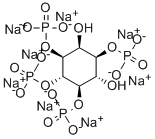
Description
D-
myo-
Inositol-
1,3,4,5-
tetraphosphate (Ins(1,3,4,5)-
P
4) is formed by the phosphorylation of Ins(1,4,5)P
3 by inositol 1,4,5-
triphosphate 3-
kinase. Ins(1,3,4,5)-
P
4 increases intracellular calcium levels by two distinct mechanisms: opening calcium channels on both the endoplasmic reticulum to release calcium from internal stores and on the plasma membrane to allow the influx of calcium from outside the cell.
Uses
D-myo-Inositol-1,3,4,5-tetraphosphate sodium is formed by the phosphorylation of Ins(1,4,5)P3 by inositol 1,4,5-triphosphate 3-kinase.
References
[1] D. BILLINGTON. Synthesis of myo-inositol 1-phosphate and 4-phosphate, and of their individual enantiomers[J]. Journal of The Chemical Society, Chemical Communications, 1987, 6 10-11: 314-316. DOI:
10.1039/c39870000314[2] D COMMUNI C E V Vanweyenberg. Purification and biochemical properties of a high-molecular-mass inositol 1,4,5-trisphosphate 3-kinase isoenzyme in human platelets.[J]. Biochemical Journal, 1994, 298 Pt 3: 669-673. DOI:
10.1042/bj2980669[3] ANDREAS LüCKHOFF David E C. Inositol 1,3,4,5-tetrakisphosphate activates an endothelial Ca2+-permeable channel[J]. Nature, 1992, 355 6358: 356-358. DOI:
10.1038/355356a0