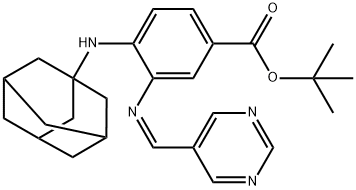
Description
SRS16-86 (1793052-96-6) is a third generation ferrostatin derivative with greater metabolic and plasma stability for in vivo studies. It protected mice in a renal severe ischemia-reperfusion injury model via inhibition of ferroptosis.1 SRS16-86 enhanced functional recovery after spinal cord injury in a rat model via upregulation of GPX4, GSH, and xCT as well as downregulation of lipid peroxidation marker 4-hydroxynonenal.2
Uses
SRS16-86 is a potent inhibitor of ferroptosis[1]. SRS16-86 is more stable than more stable to metabolism and plasma than Ferrostatin-1 in vivo. SRS16-86 can be used for renal ischemia-reperfusion injury (IRI) and spinal cord injury (SCI) research[2][3].
Definition
ChEBI: SRS16-86 is an ethyl ester resulting from the formal condensation of the carboxy group of 4-[(adamantan-1-yl)amino]-3-{(Z)-[(pyrimidin-5-yl)methylidene]amino}benzoic acid with tert-butanol. It is an inhibitor of ferroptosis induced by erastin in HT-1080 and NIH3T3 cells when used at a concentration of 1 muM. It has a role as a ferroptosis inhibitor. It is a tert-butyl ester, a member of adamantanes, a member of pyrimidines, a substituted aniline, a secondary amino compound and an imine.
in vivo
SRS16-86 (intraperitoneal injection; 2 mg/kg; 15 min before the onset of surgery) protects mice from functional acute renal failure and structural organ damage after ischemia–reperfusion injury (IRI)[2].SRS16-86 (intraperitoneal injection; 2 mg/kg; 4 weeks) combination therapy with [Nec-1+SfA] is superior in the prevention of renal IRI compared with the double-combination therapy with [Nec-1+SfA].Addition of 16-86 reduces plasma levels of serum urea and serum creatinine in IRI mice model[2].SRS16-86 (intraperitoneal injection; 15 mg/kg; once a day; 7 days) enhances functional recovery after SCI, it decreases the levels of proinflammatory cytokines and the inflammatory adhesion factor in injured spinal cord in rats[3].
| Animal Model: | Renal IRI model |
| Dosage: | 2 mg/kg; 15 min before the onset of surgery |
| Administration: | Intraperitoneal injection; 2 mg/kg; 15 min before the onset of surgery |
| Result: | Was protective from renal IRI. |
| Animal Model: | Renal IRI model |
| Dosage: | 2 mg/kg |
| Administration: | Combination with Necrostatin-1/Sanglifehrin A; 2 mg/kg; 4 weeks |
| Result: | Further increased the protective effect of [Necrostatin-1/Sanglifehrin A] combination therapy in renal IRI model. |
References
[1] ANDREAS LINKERMANN. Synchronized renal tubular cell death involves ferroptosis.[J]. Proceedings of the National Academy of Sciences of the United States of America, 2014, 111 47: 16836-16841. DOI:
10.1073/pnas.1415518111[2] YAN ZHANG . Ferroptosis inhibitor SRS 16-86 attenuates ferroptosis and promotes functional recovery in contusion spinal cord injury[J]. Brain Research, 2019, 1706: Pages 48-57. DOI:
10.1016/j.brainres.2018.10.023