Chemical Properties
almost white to beige crystalline powder
Uses
4-Cyanobenzoyl chloride has been used in the synthesis of new liquid crystalline heteroaromatic compounds containing the five-membered isoxazole, tetrazole and 1,2,4-oxadiazole rings. It has been used in the synthesis of substituted benzoate esters and to study their excited-state behavior.
Definition
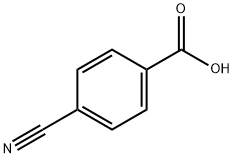
ChEBI: 4-cyanobenzoyl chloride is an acyl chloride consisting of benzoyl chloride in which the hydrogen at position 4 is replaced by a cyano group. It is a nitrile, a member of benzenes and an acyl chloride. It is functionally related to a benzoyl chloride.
General Description
4-Cyanobenzoyl chloride participates in the benzylamine acylation of Argopore MB-CHO resin in the presence of pyridine and catalyst. It reacts with 4-hydroxy-2,2,6,6-tetramethyl-1-piperidinoxyl (4-hydroxy-TEMPO) in pyridine under nitrogen atmosphere to form 4-cyanobenzoyl-TEMPO.
Synthesis
4-Cyanobenzoic acid (30.00 g, 203.90 mmol) was added to thionyl chloride (29.11 g, 244.68 mmol) in batches under magnetic stirring. Subsequently, three drops of N,N-dimethylformamide (DMF) were added to the reaction system as a catalyst. The reaction mixture was heated to reflux with continuous stirring for 1.5 h. The reaction process was monitored by thin layer chromatography (TLC). Upon completion of the reaction, the solution was distilled at 235 °C to afford the white solid product p-cyanobenzoyl chloride in 98% yield (5.50 g) with a melting point of 67.2-68.2 °C. The structure of the product was confirmed by the following characterization data: 1H NMR (600 MHz, DMSO-d6) δ 8.06 (d, J = 7.8 Hz, 2H), 7.96 (d, J = 7.8 Hz, 2H); 13C NMR (151 MHz, DMSO-d6) δ 165.9, 134.7, 132.6, 129.9, 118.1, 115.1; IR (KBr, νmax/cm-1)3101, 3051, 2229, 1772, 1739, 1597, 1401, 1287, 1211, 1167, 896, 851, 634; high-resolution mass spectrometry (HR-MS, ESI) m/z: [M + H]+ calculated value C8H4ClNO + H+ 166.0053, measured value 166.0054.
Purification Methods
If the IR shows the presence of OH, then treat it with SOCl2 boil for 1hour, evaporate and distil it in a vacuum. The distillate solidifies and can be recrystallised from pet ether. It is moisture sensitive and an IRRITANT. [Ashley et al. J Chem Soc 103 1942, Fison et al. J Org Chem 16 648 1951,[Beilstein 9 III 4255, 14 IV 3327.]
References
[1] Patent: US6433211, 2002, B1
[2] Journal of Chemical Research, 2015, vol. 39, # 9, p. 524 - 526
[3] Patent: CN107226808, 2017, A. Location in patent: Paragraph 0280-0283
[4] Annali di Chimica (Rome, Italy), 1952, vol. 42, p. 94,101