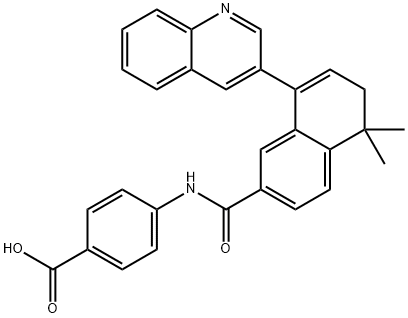
Uses
BMS-195614 (BMS 614) is an orally active neutral RARα-selective antagonist with a Ki of 2.5 nM. BMS-195614 restores the expression of Bcl2. BMS-195614 inhibits the transactivation of NF-κB, AP-1 and PPAR. BMS-195614 downregulates the expression of IL-6 and VEGF. BMS-195614 reduces blue light-induced phototoxicity and inhibits cell migration. BMS-195614 modulates inflammation and angiogenesis[1][2][3][4][5].
Definition
ChEBI: BMS 195614 is a carboxamide resulting from the formal condensation of the carboxy group of 5,5-dimethyl-8-(quinolin-3-yl)-5,6-dihydronaphthalene-2-carboxylic acid with the amino group of p-aminobenzoic acid. It is a neutral retinoic acid receptor (RAR) alpha-selective antagonist (Ki = 2.5 nM). It displays no significant effect on nuclear receptor corepressor (NCoR) binding; moderately decreases SMRT binding to RAR. It antagonizes agonist-induced coactivator (CoA) recruitment. It has a role as a retinoic acid receptor alpha antagonist. It is a member of quinolines, a member of benzoic acids and a secondary carboxamide.
References
[1] Géhin M, et al. Structural basis for engineering of retinoic acid receptor isotype-selective agonists and antagonists. Chem Biol. 1999;6(8):519-529. DOI:
10.1016/S1074-5521(99)80084-2[2] Fontaine V, et al. RAR Inhibitors Display Photo-Protective and Anti-Inflammatory Effects in A2E Stimulated RPE Cells In Vitro through Non-Specific Modulation of PPAR or RXR Transactivation. Int J Mol Sci. 2024 Mar 6;25(5):3037. DOI:
10.3390/ijms25053037[3] Kurtys E, et al. The combination of vitamins and omega-3 fatty acids has an enhanced anti-inflammatory effect on microglia. Neurochem Int. 2016 Oct;99:206-214. DOI:
10.1016/j.neuint.2016.07.008[4] Inubushi M, et al. Retinoic acid promotes migration of MC3T3‐E1 osteoblast‐like cells via RARα signaling‐mediated upregulation of profilin‐1 expression. Journal of Osaka Dental University, 2019, 53(2): 149-156.
[5] Chung SS, et al. Pharmacological activity of retinoic acid receptor alpha-selective antagonists in vitro and in vivo. ACS Med Chem Lett. 2013 May 9;4(5):446-450. DOI:
10.1021/ml300365k