Uses
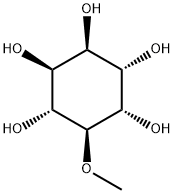
D-pinitol may be used as a starting material to prepare its azole nucleoside analogs. It may also be used in the preparation of 1D-1,5-dideoxy-1,5-difluoro-
neo-inositol and 1D-1-deoxy-1-fluoro-
myo-inositol.
Synthesis
1. Extraction of D-pinitol from plants: D-pinitol has a wide range of plant sources, and was first found in the Pinaceae family of plants, from which the name pinitol was derived. Later, D-pinitol was also found in leguminous plants, and its content is quite abundant, which greatly expanded the plant sources of D-pinitol. In addition, D-pinitol is also widely found in the flowers and leaves of the genus Leafflower, alfalfa and many other plants, and the component has also been found in the sap of some plants. In our country, D-pinitol also has very rich resources, such as in our country's Datuo Ye Yunshi, Huluba, Tibetan cat's milk, green sandalwood, bark, Aloe vera and other plant seeds as well as honey tea leaves are found to contain D-pinitol. 2. Chemical synthesis method: design a method to synthesize D-pinitol based on C2-symmetric chiral pool. Acetate undergoes ester group transfer with sodium methoxide and influences the formation of epoxide and induces a ligand opening of an allyl epoxide in its inverse reaction to provide methoxyethanol in 96% of the output, and trifluoroacetic acid is added to prepare D-pinitol after a bis-hydroxylation reaction with OSO4, and with this transformation, cheap L-(+)-tartaric acid is able to be converted to D-pinitol and L-pinitol.