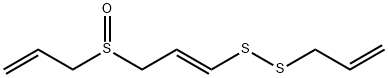
Description
(E)-Ajoene is a disulfide that has been found in
A. sativum and has diverse biological activities. It is active against Gram-positive and Gram-negative bacteria (MICs = 10-250 and 150->500 μg/ml, respectively) and fungi (MICs = 15-50 μg/ml). (E)-Ajoene inhibits proliferation of a variety of cancer cells, including MDA-MB-231 breast, HeLa cervical, and WHCO1 esophageal cancer cells (IC
50s = 18.6, 61, and 39.2 μM, respectively). It also inhibits human glutathione reductase and
T. cruzi trypanothione reductase when used at a concentration of 200 μM. (E)-Ajoene (25 mg/kg) is neuroprotective in a gerbil model of ischemia-reperfusion injury, reducing reactive astrocytosis and microgliosis in the hippocampal CA1 region.
Uses
E/Z Ajoene functions as an antioxidant, by inhibiting the release of superoxide. Ajoene also has antithrombotic (anti-clotting) properties, which helps prevent platelets in the blood from forming blood clots, potentially reducing the risk of heart disease and stroke in humans.
Definition
ChEBI: (E)-Ajoene is a sulfoxide.
References
[1] H YOSHIDA. Antimicrobial activity of a compound isolated from an oil-macerated garlic extract.[J]. Bioscience, Biotechnology, and Biochemistry, 1998, 62 5: 1014-1017. DOI:
10.1271/bbb.62.1014[2] CATHERINE H KASCHULA. Anti-proliferation activity of synthetic ajoene analogues on cancer cell-lines.[J]. Anti-cancer agents in medicinal chemistry, 2011, 11 3: 260-266. DOI:
10.2174/187152011795347450[3] HELGE GALLWITZ. Ajoene Is an Inhibitor and Subversive Substrate of Human Glutathione Reductase and Trypanosoma cruzi Trypanothione Reductase: Crystallographic, Kinetic, and Spectroscopic Studies[J]. Journal of Medicinal Chemistry, 1999, 42 3: 364-372. DOI:
10.1021/jm980471k[4] DAE YOUNG YOO . Neuroprotective effects of Z-ajoene, an organosulfur compound derived from oil-macerated garlic, in the gerbil hippocampal CA1 region after transient forebrain ischemia[J]. Food and Chemical Toxicology, 2014, 72: Pages 1-7. DOI:
10.1016/j.fct.2014.06.023