Chemical Properties
White Solid
Uses
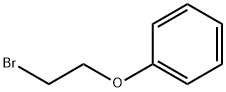
2-Phenoxyethyl bromide is used in the synthesis and antihypertensive activity of 4'-substituted spiro[4H-3,1-benzoxazine-4,4'-piperidin]-2(1H)-ones.
Application
2-Phenoxyethyl bromide can be used as a pharmaceutical intermediate for the synthesis of nafazodone and oxiperomide.
Preparation
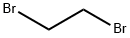
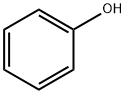
2-Phenoxyethyl bromide is synthesized by the reaction of phenol and dibromoethane. Put phenol, dibromoethane and sodium hydroxide in a reaction pot and stir and mix, react at 110 °C for 6 hours, recover dibromoethane, the recovery amount is about 60%, wash with 5% sodium hydroxide solution and water, and divide Take the oil layer, distill under reduced pressure, and collect the fractions at 130-150°C (6.7kPa) to obtain (2-bromoethoxy)benzene.
Synthesis
The general procedure for the synthesis of 2-phenoxyethyl bromide from phenol and 1,2-dibromoethane was as follows: phenol (10 mmol), 1,2-dibromoethane (50 mmol) and anhydrous potassium carbonate (30 mmol) were suspended in anhydrous acetonitrile (50 mL) under nitrogen protection. The reaction mixture was stirred at 80 °C for 6 hours. Upon completion of the reaction, the mixture was filtered to recover potassium carbonate, which could be dried under vacuum at 120 °C for 5 h to reactivate. The filtrate was concentrated under reduced pressure to remove the solvent and the resulting crude product was purified by silica gel column chromatography using petroleum ether as eluent to give the target compound 2-phenoxyethyl bromide (Scheme 1, Table 4, Entry 1). The product was a solid with a melting point of 33-34 °C. Its structure was confirmed by 1H NMR (400 MHz, CDCl3), 13C NMR (100 MHz, CDCl3) and mass spectrometry (MS).1H NMR data: δ 7.29-7.26 (m, 2H), 6.95-6.92 (m, 3H), 4.26-4.23 (t, J = 3.6 Hz, 2H), 3.61- 3.58 (t, J = 3.6 Hz, 2H).13C NMR data: δ 158, 129.5, 121.4, 114.8, 67.8, 29.1. Mass spectrometry data: m/z 202 (50, M+2), 200 (48, M+), 109 (97), 107 (100), 94 (60), 77 (29), 65 (38), 51 (22), 39 (52).
References
[1] Journal of Chemistry, 2017, vol. 2017,
[2] Bioorganic and Medicinal Chemistry, 2010, vol. 18, # 3, p. 1244 - 1251
[3] Patent: US4474964, 1984, A
[4] Patent: US4533731, 1985, A
[5] Russian Journal of Organic Chemistry, 2009, vol. 45, # 5, p. 681 - 686