Synthesis
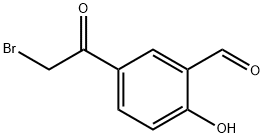
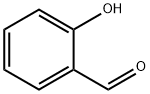
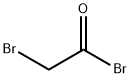
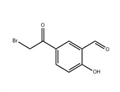
To a suspension of aluminum chloride (4 mole equivalents) in dichloromethane (10 volumes), bromoacetyl bromide (1.2 mole equivalents) was added slowly and dropwise at 100 °C, and the temperature of the reaction system was subsequently adjusted to 30 °C. The reaction mixture was stirred continuously for 1 hour, and then 2-hydroxybenzaldehyde (1 mole equivalent) was added dropwise in dichloromethane. The reaction mixture was stirred continuously at this temperature for 1 h. Then a dichloromethane solution of 2-hydroxybenzaldehyde (1 mole equivalent) was added dropwise. The reaction mixture was stirred at 35-40 °C for 12-15 hours, followed by quenching the reaction with water at 0-50 °C. The organic layer (dichloromethane layer) was separated and the solvent was removed by distillation. To the residue n-heptane was added and stirred for 15 minutes. The resulting slurry was filtered and the wet filter cake was washed with n-heptane (2 vol). The wet filter cake was dried to constant weight at 50 °C to give the intermediate 5-bromoacetyl-2-hydroxybenzaldehyde (2a). Yield: 55% (w/w); HPLC purity: 97-99
References
[1] Angewandte Chemie - International Edition, 2016, vol. 55, # 13, p. 4194 - 4198
[2] Angew. Chem., 2016, vol. 128, # 13, p. 4266 - 4270,5
[3] Tetrahedron Asymmetry, 2008, vol. 19, # 15, p. 1824 - 1828
[4] Bioorganic and Medicinal Chemistry Letters, 2013, vol. 23, # 5, p. 1548 - 1552
[5] Chemical Communications, 2018, vol. 54, # 25, p. 3106 - 3109