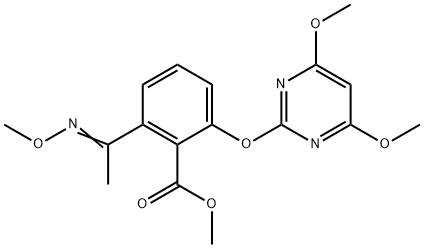
Uses
PYRIMINOBAC-METHYL (E) is suitable for rice and is safe for use on all rice varieties. At recommended dosages, it exhibits excellent selectivity for all rice varieties and can be applied at all stages of rice growth. It can be used to control barnyard grass (pre-emergence to 4-leaf stage).
Chemical Properties
Pure pyraclostrobin is white powdery solid (the original drug is light yellow granular solid), melting point 105℃[Pure (Z) type 70℃, pure (E) type 106.8℃]. Partition coefficient Kow LgP (20℃): (Z) type 2.11. Solubility (20℃, g/L): (E) type: water 0.00925, methanol 14.6, n-hexane 0.456, toluene 64.6, acetone 117, dichloromethane 510, ethyl acetate 45.0; (Z) type: water 0.175, methanol 14.0, n-hexane 4.11, toluene 852 ~1250, acetone 584, dichloromethane 2460~3110, ethyl acetate 1080~1370. stable to light and heat in water, does not decompose at 150°C, and can be stabilized at 22°C and 55°C for 14d. photolysis in water DT50 (Z) formula: 178d in natural water, 301d in distilled water.
Production Methods
Pyriminobac-methyl is commercially produced by a process that involves the esterification of pyriminobac, a pyrimidinyl benzoic acid derivative, with methanol, forming a methyl ester. The key intermediate, 2-(4,6-dimethoxypyrimidin-2-yl)oxy-6-(methoxyimino)ethylbenzoic acid, is prepared through multi-step reactions including ether formation and oxime derivatisation. The final methyl ester is purified via crystallisation or solvent extraction.
Definition
ChEBI: Pyriminobac-methyl is a benzoate ester resulting from the formal condensation of the carboxy group of pyriminobac with methanol. It has a role as an EC 2.2.1.6 (acetolactate synthase) inhibitor and a herbicide. It is an aromatic ether, an oxime O-ether, a member of pyrimidines, a benzoate ester and a methyl ester. It is functionally related to a pyriminobac.
Mechanism of action
Branched chain amino acid synthesis inhibitor. Selective, systemic, absorbed by foliage. Inhibits plant amino acid synthesis - acetohydroxyacid synthase AHAS.