Synthesis
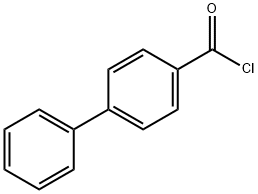
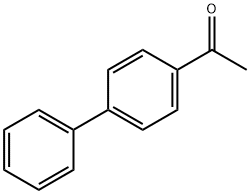
4-Biphenylcarbonyl chloride was prepared from 4-acetylbiphenyl via the following chemical reaction. The synthesis method is as follows:
While stirring at room temperature, S2Cl2 (0.16 ml, 2.0 mmol) was added to a mixture of 4-acetylbiphenyl (196 mg, 1.0 mmol), pyridine (0.012 ml, 0.15 mmol), and chlorobenzene (0.35 ml). After 2 hours, SO2Cl2 (0.121 ml, 1.5 mmol) was added dropwise, and the resulting mixture was stirred at room temperature for 0.5 hours. The mixture was then stirred at 132°C for 15 hours. The mixture was diluted with CDCI3 (2 ml), an internal standard (1BU3PO4, 0.0552 ml, 0.20 mmol) was added, and the mixture was analyzed. 1H NMR showed that biphenyl-4-formyl chloride was formed in 90% yield.
¹H NMR (PhCl, CDCI₃, 400 MHz) δ = 8.06 (d, J = 8 Hz, 2H), 7.58 (d, J = 8 Hz, 3H), 7.53 (d, J/8 Hz, 1H), 7.43–7.32 (m, 3H).
Uses
Biphenyl-4-carbonyl chloride was used in the preparation of a novel thiourea compound, N-(6-methyl pyridin-2-yl-carbamothioyl)biphenyl-4-carboxamide. It was also used in the preparation of 5-CF3-oxazole analog, 2-{4-[2-(2-biphenyl-4-yl-5-trifluoromethyl-oxazol-4-yl)-ethoxy]-phenoxy}-2-methyl-propionic acid.
Purification Methods
Dissolve the carbonyl chloride in a large volume of pet ether (10 x, b 50-70o), filter it through a short column of neutral alumina, evaporate to dryness in vacuo and recrystallise it from pet ether (b 60-80o). [Beilstein 9 IV 2480.] LACHRYMATORY.