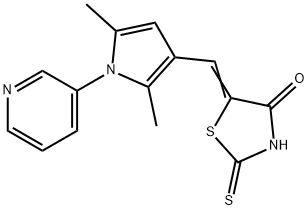
Description
Optovin (348575-88-2) is a reversible photoactive TRPA1 activator. Optovin stimulates human TRPA1 channels and enables repeated photoactivation of motor behaviors in wild-type zebrafish (EC50= 2 μM) and mice,in vivo. Photodetection is performed by sensory neurons expressing the TRPA1 cation channel which is activated via structure-dependent photochemical reactions with redox-sensitive cysteine residues.1
Uses
Optovin activates human TRPA1 via structure-dependent photochemistry.
Definition
ChEBI: Optovin is a member of the class of thiazolidinone that is rhodanine in which the two methylene hydrogens have been replaced by a 2,5-dimethyl-1-(pyridin-3-yl)-1H-pyrrol-3-yl]methylidene group. A TRPA1 ligand that can be reversibly photoactivated. It has a role as a TRPA1 channel agonist. It is a member of pyrroles, a member of pyridines, an olefinic compound and a thiazolidinone. It is functionally related to a rhodanine.
in vivo
Optovin (1-10 μM) causes light-dependent motor excitation in vivo[1].
Optovin (15 mM (20 μL); on the ear) elicits nociceptive behaviors in adult mice[1].
Optovin (10 μM; 96 h) do not affect the appearance, touch response, heart rate, fin movements, morphology or percentage survival of larvae and adult zebrafish[1].
References
[1] DAVID KOKEL. Photochemical activation of TRPA1 channels in neurons and animals[J]. Nature chemical biology, 2013, 9 4: 257-263. DOI:
10.1038/nchembio.1183