Synthesis
To a 250 ml three-necked flask, ethyl trifluoroacetate (13.60 g, 0.0958 mol), ethanol (20 ml), and a methanol solution of 28.4% sodium methoxide (16.50 g, 0.0868 mol) were added sequentially. Then, 4-fluoroacetophenone (10.00 g, 0.0725 mol) was added dropwise while stirring. After the addition was complete, the reaction solution was heated to 10–15 °C and reacted for 2.5 hours. Then, acetic acid (6.54 g, 0.109 mol) was added dropwise. After the addition was complete, 4-aminosulfonylphenylhydrazine hydrochloride was slowly added. The reaction solution was then reacted at 15 °C for 2 hours. The reaction solution was cooled to 5 °C and then the pH was adjusted to 7 with 50% sodium hydroxide. Ethanol (37 ml) and water (31 ml) were added, and the temperature was raised to 30 °C. Water (32 ml) was slowly added to the reaction solution.
The reaction solution was cooled to 5°C, filtered, and the filter cake was washed twice with 50% ethanol-water solution (v/v, 50 g). The filter cake was vacuum dried to give 20.109 g of the final product, with a yield of 72.0%.
Definition
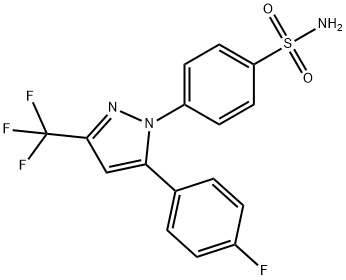
4-[5-(4-FLUOROPHENYL)-3-(TRIFLUOROMETHYL)PYRAZOL-1-YL]BENZENE-1-SULFONAMIDE is a member of the class of pyrazoles that is 1H-pyrazole which is substituted at positions 1, 3 and 5 by 4-sulfamoylphenyl, trifluoromethyl and 4-fluorophenyl groups, respectively. A selective cyclooxygenase 2 inhibitor, it is used in vete inary medicine to treat pain and inflammation in dogs with degenerative joint disease.