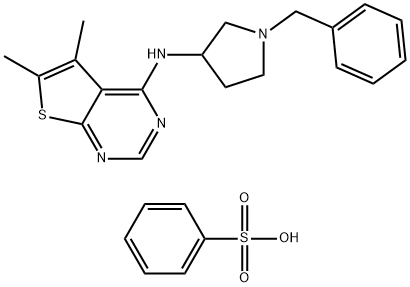
Description
Fasnall is an inhibitor of fatty acid synthase (FASN) with an IC
50 value of 3.71 μM for the human recombinant enzyme.
1 It inhibits tritiated acetate incorporation into lipids (IC
50 = 5.84 μM), increases ceramide accumulation, and induces the formation of lipid droplets in BT474 HER2
+ breast cancer cells. Fasnall has antiproliferative activity against non-tumorigenic MCF-10A and tumorigenic MCF-7, MDA-MB-468, BT474, and SK-BR-3 breast cancer cells that directly correlates to the level of FASN expression
in vitro. It reduces tumor volume and increases survival in the murine MMTV-Neu model of HER2
+ breast cancer. Fasnall also potentiates carboplatin response
in vivo, increasing the objective response rate of stable disease from 25% for carboplatin alone to 88% for carboplatin with fasnall.
Uses
Fasnall benzenesulfonate is the benzenesulfonate salt form of Fasnall (HY-121250). Fasnall benzenesulfonate is the inhibitor for fatty acid synthase (FASN) with IC50 of 3.7 μM. Fasnall benzenesulfonate inhibits the proliferation and induces apoptosis in breast cancer cells. Fasnall benzenesulfonate exhibits antitumor efficacy in mice[1].
References
1. Alwarawrah, Y., Hughes, P., Loiselle, D., et al.
Fasnall, a selective FASN inhibitor, shows potent anti-tumor activity in the MMTV-Neu model of HER2+ breast cancer Cell Chem. Bio. 23(6),678-688(2016).